
Sixteen days after this guide goes live, the grace period ends for medical devices that were on the EU market before 28 May 2026 and are still being placed on it. By 28 November 2026, each of those devices must be registered in EUDAMED, the EU’s medical device database, under its device identifier. For anyone importing medical devices into the EU, that turns a database entry into a check the importer must make for every device it places on the market.
The short version. The EU importer of a medical device must be established in the EU, be registered in EUDAMED with its own number, and check each device before placing it on the market. That check covers CE marking, the declaration of conformity, the EU authorised representative, the labelling and instructions, and the device identifier. The importer must also confirm the device is registered in EUDAMED, which older devices must be by 28 November 2026, and add its own details. Customs can suspend release for free circulation when required documents are missing, marking is false or misleading, or the importer cannot be identified.
Carra Globe provides importer of record, delivered duty paid and white glove delivery services, so we have a commercial interest in your answer. What follows is written to be usable whether or not you ever speak to us.
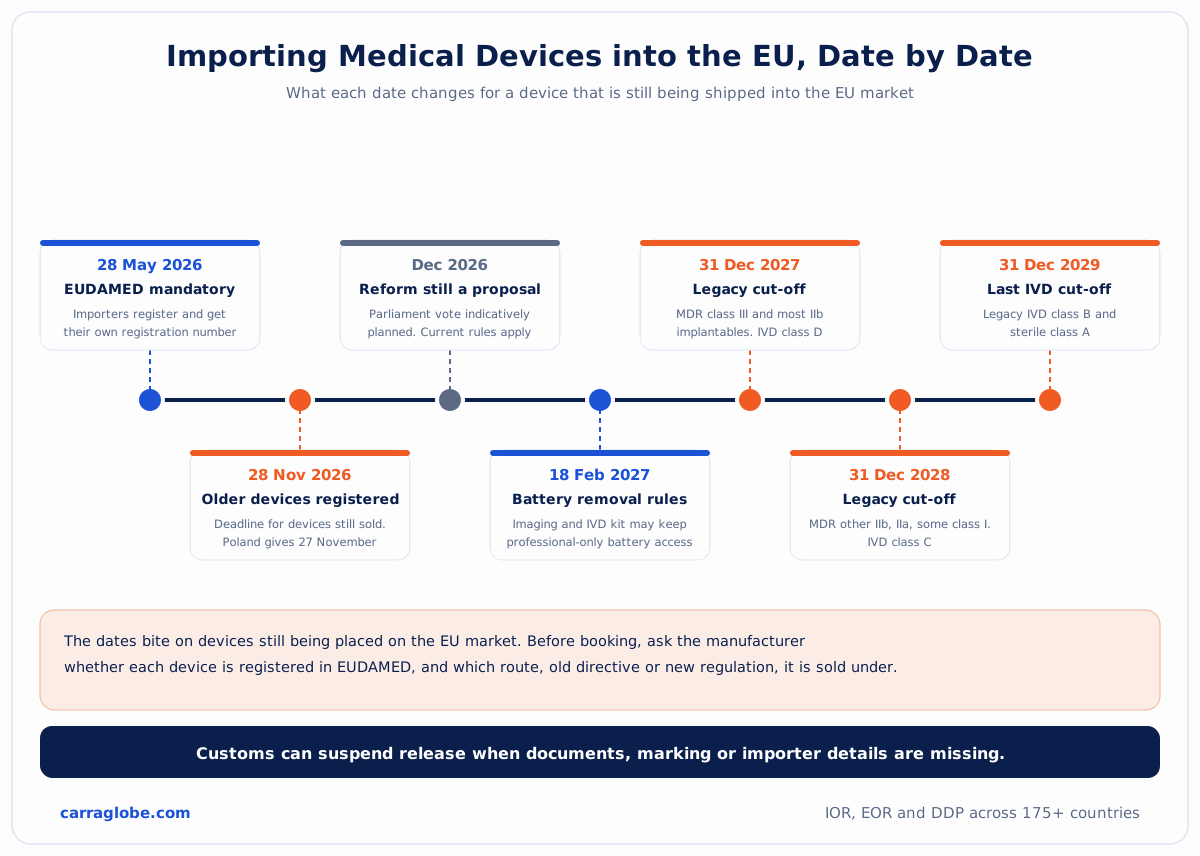
What changes on 28 November 2026
The database has been mandatory since May. Four EUDAMED modules became mandatory on 28 May 2026, six months after the Commission confirmed in the Official Journal that they worked. From that date, importers had to register as actors and obtain a Single Registration Number, and new devices had to be registered before their first unit was placed on the market.
November closes the transition for older devices. Under the 2024 amendment to the medical device regulations, manufacturers have until 28 November 2026 to register devices first placed on the market before May, if further units are still being placed. That covers legacy devices still sold under the old directives as well as devices certified under the newer rules, but not custom-made devices, which follow their own route.
Poland states the date differently. Poland’s medical device regulator gives the last day as 27 November 2026, while the Commission’s timeline marks 28 November as the deadline. Both describe the same transition. EU law sets the deadline 12 months after the Commission’s November 2025 notice, which gave devices already on the market six more months once the database became mandatory. Registering by 27 November meets either reading.
Who the importer is, and why it matters for your shipment
The importer is a legal role, not a logistics one. Under the Medical Devices Regulation, the importer is the EU-established person that places a device from outside the EU on the Union market. This is a product-law role, separate from the importer under the customs code, and it is not the same as what an importer of record does for customs purposes, although one company can hold both roles.
The importer’s name and address must appear on the device, its packaging or an accompanying document. Before placing any device other than a custom-made one on the market, the importer must register in EUDAMED and receive its Single Registration Number.
National rules can add a step. Since August 2026, Romania’s medicines and medical devices agency has required importers to hold an EUDAMED importer number before it grants or amends their operating permit for import activity.
The checks before Importing Medical Devices into the EU
Article 13 of the Medical Devices Regulation lists what the importer must verify. In-vitro diagnostic equipment follows matching rules under the separate regulation for those devices. Gather the evidence before the shipment leaves, because the importer cannot place a device on the market if it has reason to think the device does not comply.
| Check | What to have in hand |
|---|---|
| CE marking and declaration | The EU declaration of conformity, and any notified body certificate the device class needs |
| Manufacturer and representative | The manufacturer’s details and, where the manufacturer is outside the EU, its designated EU authorised representative |
| Labelling and instructions | Labels and instructions for use as the regulation requires, in the languages the destination country accepts |
| Device identifier | The unique device identifier assigned by the manufacturer, where required |
| EUDAMED registration | The device’s entry in EUDAMED, to which the importer adds its own details |
| Importer details | The importer’s name and address on the device, packaging or accompanying document, without hiding the manufacturer’s label |
| Storage and transport | Conditions that keep the device compliant in transit, following any manufacturer instructions |
Keep a copy of the declaration of conformity and any certificate for as long as the manufacturer must, which runs to at least ten years after the last device is placed on the market, or fifteen for implantables. Our guide to HS codes for medical devices covers the tariff side of the same shipment.
If a device is not in EUDAMED
- Search the public EUDAMED site for the manufacturer’s registration number and the device before the shipment leaves.
- If the device is missing, ask the manufacturer whether it is registered under another identifier, or when it will be.
- Until 28 November, an older device can still be placed while its registration is pending. Where registration is already required and the manufacturer cannot confirm it, hold the goods at origin until it can.
- Once it is registered, add the importer’s details to the device record.
- If the goods have already reached the EU, ask your customs broker whether they can wait in customs storage while the record is completed. Any hold placed by the regulator has to be cleared with that regulator first.
What customs can stop at the border
Customs can suspend release, not just delay it. The EU’s market surveillance regulation lets customs suspend release for free circulation when documents required by EU law are missing, marking is false or misleading, or the economic operator’s name and address are not identifiable. Those powers apply to products covered by EU law where no more specific border rules exist, and national customs guidance applies them to medical devices.
Poland shows how it works in practice. Its customs guidance, published in December 2025, names its medical device regulator as the authority customs consults. It lists the same grounds for refusal and gives the regulator three working days to give an opinion on a held shipment. If the opinion is negative, the goods are marked non-compliant or dangerous and are not released.
EUDAMED is not an automatic border check. We found no official sign that customs checks every device against EUDAMED automatically. Where registration is already required, a missing record is a compliance failure for the manufacturer and the importer, and it becomes visible the moment a regulator asks.
Older devices and the 2027 to 2029 cut-offs
Medical devices run to 2027 or 2028. Eligible devices sold under the old directives, with a certificate or, for some former class I devices, a declaration of conformity, may continue to be placed on the market until 31 December 2027 for class III devices and most class IIb implantables, and until 31 December 2028 for other class IIb, class IIa and some class I devices.
The dates come with conditions. The device must still meet the old rules, with no significant change in design or purpose and no unacceptable risk to health or safety, and the manufacturer must have had a quality system in place and applied to a notified body by 26 May 2024, with a written agreement by 26 September 2024.
IVD equipment runs to 2029. Eligible legacy IVDs with a notified body certificate under the old directive, and class D devices, may continue to be placed on the market until 31 December 2027, class C until 31 December 2028, and class B and sterile class A until 31 December 2029. Their conditions differ too. The quality system had to be in place by 26 May 2025, and the manufacturer must have applied to a notified body by 26 May 2025, 2026 or 2027, depending on the class, with a written agreement by 26 September of the same year.
Ask the manufacturer whether each product is a medical device or an IVD, and which route it uses, before booking. A legacy device that fails one of those conditions cannot rely on the extended dates, whatever its certificate says.
Electrically powered equipment carries extra rules
Monitors, imaging systems, laboratory analysers and other powered equipment usually have to meet more than the medical device rules.
| Rule | How it reaches medical equipment |
|---|---|
| Hazardous substances (RoHS) | Medical devices are a covered category, with specific exemptions, while active implantables are excluded |
| Waste electrical equipment (WEEE) | Producer registration in each country where the importer counts as the producer, subject to scope exclusions such as devices expected to be infective at end of life |
| Batteries Regulation | Applies to batteries in or with the equipment. From 18 February 2027, professional imaging, radiotherapy and in-vitro diagnostic equipment may be designed so that only independent professionals replace its portable batteries |
| Radio Equipment Directive | Applies where the device has Wi-Fi, Bluetooth, cellular or other radio functions |
Our guides to WEEE producer obligations, the EU Batteries Regulation and CE marking for importers cover each in more depth, and lithium battery customs clearance covers the shipping side of battery-powered kit.
What the proposed reform does not change yet
The Commission proposed a broad simplification of the medical device regulations in December 2025. It has not been adopted. The Parliament’s health committee is still working on it, with a first-reading plenary indicatively set for December 2026. Until any change is adopted and published, importers apply the current rules, including the November EUDAMED deadline.
How Carra Globe handles medical equipment imports into the EU
Carra Globe and its team ship diagnostic and imaging equipment, patient monitoring devices, laboratory and in-vitro diagnostic equipment, and surgical and hospital equipment into EU countries, including large powered and battery-equipped machines. Shipments go wherever the hospital or client site is, from Germany and the Netherlands to France and Belgium.
The EU importer depends on the shipment. Sometimes it is the client’s own EU company, and sometimes it is the importing structure we arrange as importer of record, which can also take the importer role under the medical device rules. Where it does, its duties under those rules are agreed before shipment.
When the paperwork is complete, customs clearance usually takes from the same day to one working day. Duty is paid or deferred through the customs entry, and import VAT is paid at import or, where the country allows, accounted for on the VAT return. Shipments selected for inspection or referred to the regulator take longer. For devices leaving another market, we also act as exporter of record.
Carra Globe works through importer-side registrations and local importing structures appropriate to the goods and destinations it accepts, its own in some markets and established local structures in others. Approvals falling outside the available structure are flagged before a delivery date is agreed.
For a quote, send the following, and our trade compliance team reviews the device file first. Reach us at info@carraglobe.com.
- The draft commercial invoice with item names, quantities and unit values
- Device names, models and classes, with the EU declaration of conformity and any certificate
- The EU authorised representative and the proposed EU importer
- The Basic UDI-DI or UDI-DI of each model, or the EUDAMED identifier for a legacy device, with its registration status or the manufacturer’s plan to meet the November deadline
- Datasheets, and for lithium batteries the safety data sheet and UN 38.3 test summary
- Weights and dimensions, and the collection and hospital or site addresses
Medical Devices · EU Import · EUDAMED · Customs
Send the device list and the destination. We will check the importer, the device file and the EUDAMED status before anything ships.
A CE-marked device can still wait at the border if the documents, the labels or the importer details are not in order. So the useful conversation starts with the device classes, the declaration of conformity and who will be the EU importer. Where something sits outside the structure available, you hear that before a delivery date is agreed.
- Indirect representation, duty and import VAT
- Using the Netherlands as an EU distribution hub
- Importer of record in Ireland
- Importer of record in Italy
- Importer of record in Spain
- Customs clearance for emergency spare parts
- DDP versus importer of record
- How to verify an importer of record provider
- Importer of record versus customs broker
- EU air cargo security in 2026
- Global warehouse logistics
- Freight forwarding services
- Multi-country equipment deployments
- Cargo insurance for high-value equipment
- Importer of record when there is no sale
Free tools HS Code Finder Volumetric Weight Calculator
Shipping medical equipment into the EU? Send the draft invoice, device models and classes, the declaration of conformity and any certificate, the EU authorised representative, weights and dimensions, and the hospital or site address. We will come back on the importer, customs and timing.
Check my medical shipmentFrequently asked questions
What does the 28 November 2026 EUDAMED deadline mean for importers?
Older devices still being placed on the EU market must be registered by then. Importers must check each device is registered and add their own details.
Who is the importer of a medical device under the MDR?
The EU-established person that places a device from outside the EU on the Union market. It must register in EUDAMED and appear on the device, packaging or documents.
Can EU customs stop a medical device shipment?
Yes. Customs can suspend release when required documents are missing, marking is false or misleading, or the economic operator cannot be identified.
Do legacy medical devices need EUDAMED registration?
Yes, if further units are placed on the market after 28 May 2026. The Commission gives the deadline as 28 November 2026, while Poland’s regulator gives 27 November.
How long can legacy devices still be placed on the EU market?
Under the MDR, until the end of 2027 or 2028 depending on class. Eligible legacy IVDs run to the end of 2027, 2028 or 2029. Conditions apply.
Does RoHS apply to medical devices?
Yes. Medical devices are a covered category under RoHS, with specific exemptions. Active implantable medical devices are excluded.
Has the EU simplified the medical device rules yet?
No. The Commission’s December 2025 proposal is still before the Parliament and Council, so the current rules and deadlines apply.
Can a company outside the EU be the medical device importer?
No. The MDR importer must be established in the EU, and a non-EU manufacturer also needs an EU authorised representative.
Adjacent ground: importing medical devices without a local entity and importer of record for medical devices.
Sources and verification
Each rule was checked against EU legislation and official regulator or customs publications available on 12 November 2026, using the newest version we could find.
- Medical Devices Regulation. Regulation (EU) 2017/745, including Articles 13, 31 and 120, Regulation (EU) 2023/607 on the transition and Regulation (EU) 2024/1860 on the gradual roll-out of EUDAMED and the IVD transition, and the In Vitro Diagnostic Medical Devices Regulation (EU) 2017/746.
- EUDAMED. Commission Decision (EU) 2025/2371, the Commission’s EUDAMED readiness page and device registration timeline, Ireland’s HPRA on mandatory EUDAMED use and Poland’s URPL notice of 25 May 2026.
- National importer rules. Romania’s medicines and medical devices agency, notice of 17 August 2026.
- Border controls. Regulation (EU) 2019/1020, Articles 2 and 25 to 28, and Polish customs guidance on market surveillance at the border, December 2025.
- Electrical equipment. RoHS Directive 2011/65/EU, WEEE Directive 2012/19/EU, Batteries Regulation (EU) 2023/1542, Article 11, and the Radio Equipment Directive 2014/53/EU.
- Proposed reform. The Commission’s proposal COM(2025) 1023 of December 2025 and the European Parliament’s procedure file 2025/0404(COD).
Disclaimer: This guide is for informational purposes only and does not constitute legal, customs or regulatory advice. Requirements depend on the specific device, its class and conformity route, the destination country, the importer and the intended use. The position described is as at 12 November 2026. Confirm the current position with the manufacturer, the relevant competent authority and your importer of record before shipping.