
Appointing an importer of record is a contractual act. You sign something, a company agrees to be named, and from that point everyone involved treats the question as settled. The new Union Customs Code does not settle it that way. Article 5(13) identifies the importer by applying five descriptions in a fixed order, and none of the five is an agreement between the parties. What you signed can be evidence of who decided what. It is not the test.
The short version. Regulation (EU) 2026/2108 establishes the Union Customs Code and repeals Regulation (EU) No 952/2013. It entered into force on 20 September 2026 and applies generally from 21 September 2027 under Article 287(2). Outside distance sales, Article 5(13) finds the importer by working through five descriptions in order. Article 27(1) then states there shall be only one importer at a time, and Article 27(3) requires that importer to be established in the Union unless a listed exception applies.
Carra Globe provides importer of record, exporter of record, delivered duty paid and freight forwarding services, so we have a commercial interest in your answer. What follows is written to be usable whether or not you ever speak to us.
What actually changes, and when
The Code is being replaced, not amended. Regulation (EU) 2026/2108 establishes the Union Customs Code and the European Union Customs Authority and repeals Regulation (EU) No 952/2013. It was published on 19 September 2026 and entered into force the next day under Article 287(1). Article 287(2) sets the general application date at 21 September 2027.
Not every provision waits for that date. Article 287(3) lists provisions already applying since entry into force, and Article 287(5) lists a further set that applies from 1 July 2028. The date that governs you is the one attached to the article you are relying on, not a single headline date.
The Data Hub timetable sits in Article 285, not only in the recitals. Until 30 June 2028, all goods intended to be placed under a customs procedure are to be covered by a customs declaration appropriate for that procedure. From 1 July 2028 the requirements in Article 285(2) bite on importers for distance sales and persons using the IOSS scheme. Other importers, exporters and holders of the transit procedure carry on lodging customs declarations until 28 February 2031, may use either route from 1 March 2031, and have to use the Data Hub from 1 March 2034.
Two other dates in Article 285 are build milestones rather than operator deadlines. The functionalities behind the 2028 obligation are due by 1 June 2028 and the Data Hub is to be fully operational by 1 February 2034, with Article 285(7) allowing a transitional solution of up to six months if a functionality is late.
Much of the public discussion so far addresses e-commerce platforms and distance sellers. If you move hardware and data centre equipment business to business, most of that coverage does not describe your situation. Three provisions do. Article 5(13) identifies the importer, Article 27 sets out that person’s obligations and the establishment requirement, and Article 285 governs the move to the Data Hub.
The importer is now identified by a test
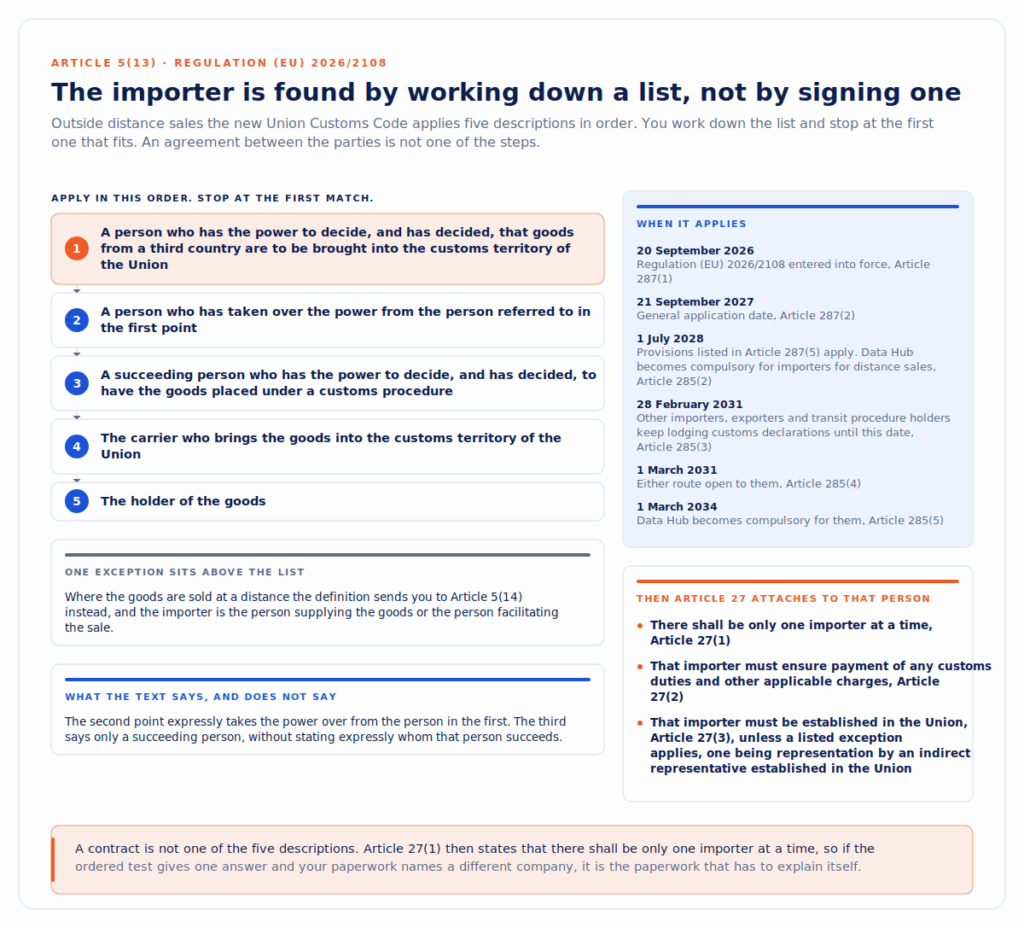
Article 5(13) defines the importer. In the case of distance sales it is the importer for distance sales, which Article 5(14) defines as either the person supplying the goods or the person facilitating the sale. In every other case, meaning ordinary business to business imports, it is the person determined by applying five descriptions in order.
- A person who has the power to decide and has decided that goods from a third country are to be brought into the customs territory of the Union.
- A person who has taken over the power from the person referred to in the first point.
- A succeeding person who has the power to decide and has decided to have the goods placed under a customs procedure.
- The carrier who brings the goods into the customs territory of the Union.
- The holder of the goods.
Read the two middle points carefully. The second expressly takes the decision-making power over from the person in the first. The third uses the phrase a succeeding person without saying expressly whom that person succeeds, which is a gap worth noticing rather than filling with an assumption. The list above is condensed, and the full wording sits at Article 5(13) of Regulation (EU) 2026/2108 on EUR-Lex. It is worth reading once in the original.
The order is the whole point. You do not pick the description that suits the paperwork. You work down the list and stop at the first one that fits. For a business to business hardware shipment the opening question is who held the power to decide that the goods would be brought into the Union and actually took that decision. Often that is the buyer, but a commercial role does not answer it on its own.
Article 5(13) sets out no checklist for answering that question. In practice the evidence tends to sit in who specified the kit, who placed the order and who could have stopped the shipment, which is a reason to document those things on an EU lane rather than assume them.
Article 27(1) states that there shall be only one importer at a time. That is operative text rather than a recital, and it is what turns the ordered test into something more than labelling. If your contract names one company and the Article 5(13) test points at another, the contract does not reconcile the two. It does not mean nobody else has a role, because the importer, the declarant, the customs representative and the carrier can all be different parties.
What this does to an importer of record arrangement
Importer of record is a commercial term. It does not appear in the Code, and it never did. What has changed is that the Code now carries its own definition of importer, a chapter of obligations attached to whoever that is, and a rule that there is only one of them at a time.
The arrangement is not automatically invalidated. Someone still has to lodge the declaration, and the rules on representation still decide who may do that. Our note on indirect representation and who owes the duty and the import VAT sets out that machinery under the Code in force today. What the new definition changes is whether the person your structure treats as the importer is the same person Article 5(13) identifies.
Article 27(2) is the part to read before you sign anything. It places on the importer the duty to provide and keep the information required for the procedure, to ensure payment of any customs duties and other applicable charges, to ensure the goods comply with other legislation applied by the customs authorities and keep records of that compliance, and to notify customs of information about suspicious movements or unauthorised handling of goods that it is aware of. Those obligations attach to the importer the Regulation identifies, and a services agreement naming a company as importer of record does not by itself decide that identity.
The declarant and the importer are not the same person. The Regulation defines them separately at Article 5(54) and Article 5(13), so a buyer who believes that appointing a provider makes that provider the importer has believed something the definition does not support. Treating the two as one was always loose. From 21 September 2027 it is loose against a definition that is written down.
The practical consequence is that the structure you use starts to matter more than the label you put on it, which is the distinction we drew in paper IOR versus operational IOR and the thing to probe when choosing an importer of record.
Customs is also not the only EU regime that uses the word importer. If your exposure runs through product compliance as well as entries, our notes on the Cyber Resilience Act for importers and importer liability under the digital product passport sit alongside this one.
The importer must generally be established in the EU
Article 5(13) says who the importer is. Article 27(3) says where that person has to be. The two have to be read together, and a good deal of the commentary reads only the first.
The rule, then the exceptions. Article 27(3) states that the importer shall be established in the customs territory of the Union. It then disapplies that requirement for an importer that places goods under the transit or temporary admission procedure, that brings goods remaining in temporary storage, that only occasionally places goods under customs procedures where the authorities consider it justified, that is established in an adjacent country granting reciprocal benefits and presents the goods at an adjacent border customs office, or that is represented by an indirect representative established in the Union.
The last exception is the one most non-EU buyers will rely on. It can matter a great deal to a company importing IT equipment without a local entity. Where it applies, the importer is not itself required to be established in the Union on that basis. It is specific rather than general, because the representative has to be an indirect representative established in the customs territory of the Union, so it is not a permission to use any provider or any form of representation.
It does not make that representative the importer. Who the importer is under Article 5(13) and how the establishment requirement in Article 27(3) is met stay two questions, answered by two different articles, and both have to be assessed for the particular arrangement rather than settled once for a provider.
If you are planning EU lanes that run past 21 September 2027, there are two questions to put to a provider rather than one. Which of the five descriptions in Article 5(13) do they expect to satisfy, and which do they expect you to satisfy. Then, for whoever comes out as the importer, how is Article 27(3) met on that shipment. A provider that has not read Article 27 will answer the first question confidently and the second one not at all.
How Carra Globe works with this
We are directly exposed to this. That is the reason we read the articles rather than the summaries. Carra Globe handles hundreds of EU import entries a year, and not through one structure. Depending on the commodity and the client we import through our own entity, through a local importing structure, or through a partner acting as indirect representative. A consignment of AI servers and GPU clusters and a routine enterprise hardware refresh can take different routes for that reason.
Those three routes do not sit in the same place against an ordered test, and they do not satisfy Article 27(3) the same way either. That is precisely why the honest answer to a client asking about 2027 is a question about their lane rather than a reassurance about ours.
Carra Globe works through importer-side registrations and local importing structures appropriate to the goods and destinations it accepts, its own in some markets and established local structures in others, and approvals falling outside the available structure are flagged before a delivery date is agreed. Where an EU lane is involved, that now includes being explicit about which structure is carrying it and how the establishment requirement is met on it.
If you are building EU lanes into 2027, start by sending us the destination, the commodity and who is making the buying decision. That is where the assessment begins rather than where it ends, because the decision-making arrangements, the customs procedure and the representation structure all bear on the answer.
Country detail sits in Germany, the Netherlands, Ireland and France. There is more on Belgium, Spain and Italy. Reach us at info@carraglobe.com.
Union Customs Code 2027 · Who Is The Importer
From 21 September 2027 the Code answers that question itself. Make sure your lane answers it the same way.
Article 5(13) of the new Union Customs Code works down five descriptions in order and stops at the first one that fits. A contract is not one of them, and Article 27 then attaches the duties, the single-importer rule and an EU establishment requirement to whoever the test lands on. So the useful conversation is not whether a provider will be named as your importer of record. It is which description each party expects to satisfy on your lane, and whether the entry is carried by our own entity, a local importing structure or a partner acting as indirect representative. We will tell you which one is carrying yours, and we will say so before a delivery date is agreed.
- Importing into Germany with no entity
- EU dual-use export controls
- EU battery rules for importers
- EU air cargo security 2026
- Encryption import restrictions
- What an importer of record is
- How to verify an IOR provider
- When the customer will not be IOR
- IOR for data centre equipment
- Multi-country deployment
- IT hardware import rules by country
- Exporter of record in Germany
- Exporter of record in the Netherlands
- IOR by country
- EOR by country
Free tools HS Code Finder Volumetric Weight Calculator Pallet Calculator
Planning EU lanes that run past 21 September 2027? Send the destination, the commodity, the full technical specification per model and who is making the buying decision. We will come back on which structure fits, who answers as importer on that structure, how Article 27(3) is satisfied on it, and what to confirm before the goods move.
Check my EU routingFrequently asked questions
When does the new Union Customs Code apply?
Regulation (EU) 2026/2108 entered into force on 20 September 2026 and applies generally from 21 September 2027 under Article 287(2). Articles 287(3) and 287(5) set different dates for listed provisions.
Who is the importer under the new Code?
Outside distance sales, the person found by applying five descriptions in order, beginning with whoever had the power to decide and decided that the goods would be brought into the Union.
Does an importer of record contract decide who the importer is?
Not by itself. Article 5(13) applies five descriptions in order and an agreement is not one of them. The contract and the operational arrangements can still evidence who held the decision-making power.
Can there be more than one importer at a time?
No. Article 27(1) states that there shall be only one importer at a time. Other parties can still hold other roles, since the declarant, the customs representative and the carrier are defined separately.
Must the importer be established in the EU?
Article 27(3) requires it, then lists exceptions. One covers an importer represented by an indirect representative established in the Union. Which exception applies depends on the procedure and the parties involved.
Is the importer the same as the declarant?
No. The Regulation defines them separately, the declarant at Article 5(54) as the person lodging the declaration, and the importer at Article 5(13) by the ordered test.
Adjacent ground: importing into a new country without a local entity, import VAT and the importer of record and what an EORI number is.
Sources and verification
Checked in the Official Journal text on 13 October 2026. The body above quotes these provisions in full, so this list gives the article numbers rather than repeating them.
- The Regulation: Regulation (EU) 2026/2108 of 16 September 2026, establishing the Union Customs Code and the European Union Customs Authority and repealing Regulation (EU) No 952/2013. Published 19 September 2026.
- Who the importer is. Article 5(13) for the ordered test and Article 5(14) for the importer for distance sales.
- What attaches to that person. Article 27(1) for only one importer at a time, Article 27(2) for the obligations, and Article 27(3) for the establishment requirement and its five exceptions.
- Who else holds a role. Article 5(54) for the declarant and Article 5(20) for the customs representative.
- When it applies. Article 287(1) for entry into force, Article 287(2) for general application on 21 September 2027, Article 287(3) for provisions already applying, and Article 287(5) for those applying from 1 July 2028.
- The Data Hub timetable. Article 285(1) to (5) for the operator dates from 30 June 2028 through 28 February 2031 to 1 March 2034, and Article 285(2), (6) and (7) for the build milestones of 1 June 2028 and 1 February 2034 and for the six-month transitional solution where a functionality is late.
- Recital 119 gives policy context for voluntary Data Hub use from 1 March 2031 and intended use by all operators by 1 March 2034. It does not carry the full timetable, which is in Article 285.
- Verification note. Each article above was read in the Official Journal text rather than in commentary. Delegated and implementing acts were not all published when this was written and can affect how a provision operates. Nothing here is advice on your shipments. Confirm the position with the customs authority or a qualified adviser before relying on it.
Disclaimer: This guide is for informational purposes only and does not constitute legal, customs or trade compliance advice. The Union Customs Code established by Regulation (EU) 2026/2108 is subject to delegated and implementing acts that were not all published at the time of writing, and its application depends on the goods, the parties and the member state. The position described is as at 13 October 2026. Confirm the current position with the competent authority or a qualified adviser before acting.