
From 5 January 2027, every US entry for consumption filed on CBP Form 3461 or 7501 has to answer a question it never asked before. Is the importer of record a US importer? If not, a foreign importer of record can only clear goods by holding CBP’s CTPAT security validation itself, or through a customs broker that does. For companies outside the US that sell on delivered duty paid terms, that changes who can file the entry.
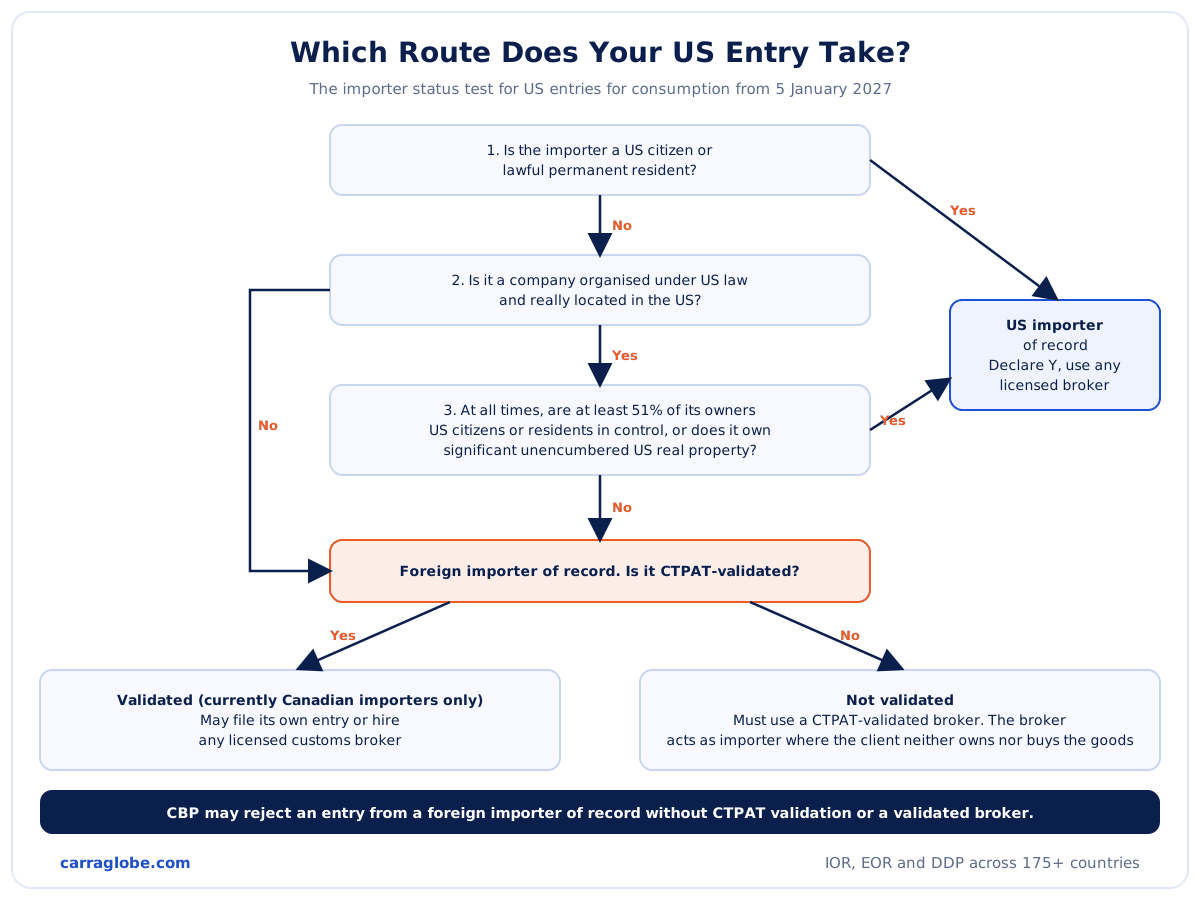
The short version. CBP’s interim final rule, published on 6 November 2026, takes effect on 5 January 2027. A US importer of record is a US citizen or permanent resident, or a company organised and located in the US that either has US citizens or permanent residents as at least 51% of its beneficial owners, in control of it, or owns significant unencumbered US real property. Every other importer is a foreign importer of record, which must be CTPAT-validated or use a CTPAT-validated licensed customs broker. Every entry must declare which it is.
Carra Globe provides importer of record, delivered duty paid and freight forwarding services, so we have a commercial interest in your answer. What follows is written to be usable whether or not you ever speak to us.
What changes on 5 January 2027
It covers the entries business shipments use. The interim final rule, CBP Dec. 26-19, carries out the June 2026 customs enforcement executive order. It applies to all formal entries for consumption and to informal entry types 11, 12 and 13, including withdrawals from a bonded warehouse or foreign trade zone. From 5 January, CBP may reject entries from a foreign importer that has neither its own validation nor a validated broker. Comments close the same day, but they do not delay the rule.
Every entry declares the importer’s status. Three new data fields on CBP Forms 3461 and 7501 record whether the importer, or the principal behind a broker acting as importer, meets the US criteria. Where a broker that is not CTPAT-validated acts as importer for a US principal, that principal must also have CBP Form 5106 on file.
Brokers carry more of the risk. A broker must check a client’s records before declaring it a US importer, and keep them for five years from the check. A false or negligent declaration that breaches the customs fraud and negligence statute can now bring a penalty under it. Eligible brokers can ask CBP for more time on the checks until 6 May 2027, but not on the CTPAT requirement.
Are you a US importer of record? Three checks
Ownership and real operations decide it, not a US address or tax number, and CBP can verify it at any time. If you are new to what an importer of record does, start there.
- Is the importer a US citizen or lawful permanent resident? If so, it is a US importer of record, and the other checks do not apply.
- Is the company organised under US law and located in the US? CBP looks at the principal place of business, a real operating presence, US assets, whether sales generally exceed the cost of goods sold, and capitalisation. A US company set up mainly to import for a foreign maker may fail here.
- Does it pass one of two tests at all times? Either US citizens or permanent residents make up at least 51% of its beneficial owners and control it, or it directly owns significant unencumbered US real property. A beneficial owner is a person with substantial control or at least 25% ownership, directly or indirectly, so this is not a simple share count. CBP’s FAQs set the property amount at 100% of the prior year’s entered value or $20 million, whichever is greater.
A company must pass checks two and three, or it is a foreign importer of record. Status can change after a share sale or a fall in property holdings, so the check is not a one-off.
Your routes if you are a foreign importer of record
| Route | Who files the entry | Fits when | Watch for |
|---|---|---|---|
| Become CTPAT-validated yourself | You, or any licensed customs broker | You are a Canadian importer, as only Canadian foreign importers can currently be validated | Validation needs a security profile and CBP validation, so it is not a quick fix |
| Use a CTPAT-validated broker | A CTPAT-validated licensed broker, with you as importer of record | You own or buy the goods and want to stay importer of record | Fewer brokers hold validation, so check status on CBP’s published broker list |
| Have the validated broker act as importer | The CTPAT-validated broker, as importer of record for the entry | Required where the foreign principal neither owns nor buys the goods | Power of attorney and broker terms need updating |
| Move the importer role to a US buyer | Your US customer, usually under DAP terms | The buyer qualifies as a US importer of record and accepts the role | Changes pricing, duty liability and who controls clearance |
Filing through a validated broker does not make the broker your importer of record. You stay importer where you own or buy the goods. CBP is also clear that an application for validation, by you or your broker, does not count until it is granted.
What it means if you sell on delivered duty paid terms
DDP sellers are often the importer of record. Under DDP, the seller usually clears the goods and pays the duty, so it, or the provider it appoints, is often the importer. A UK, European or Asian reseller shipping servers, network equipment or laptops to a US data centre on those terms is likely to be a foreign importer of record. Our comparison of DDP and DAP explains who carries which costs.
A worked example. A UK reseller sells two network switches to a US data centre on DDP terms and owns them until delivery. It fails the US test, so it is a foreign importer of record. From 5 January, a CTPAT-validated broker files the entry with the reseller as importer, under the reseller’s power of attorney and customs bond. Before 5 January, any licensed broker could have filed it.
A US subsidiary may not be enough. A US company owned by a foreign group can still fail the US test. Its broker will ask for corporate charters, beneficial owner details, financial statements and proof of US property or assets, as part of a wider push on CBP customs audits.
Switching to DAP moves the question to your buyer. The buyer then pays the duty, controls the entry and must pass the US test or use a validated broker itself. Agree this in the contract before goods ship, and see our guide on what to do when a customer will not be importer of record.
Five things to do before 5 January
- Test each importer you use. Decide whether it is a US or a foreign importer of record under the three checks.
- Check your broker. Confirm it appears on CBP’s list of CTPAT-validated brokers, not just that it has applied.
- Update the paperwork. Make sure your customs power of attorney and broker terms say who acts as importer.
- Gather ownership records. Have beneficial owner and property evidence ready for the broker’s checks.
- Review January shipments. Goods shipped in December but entered from 5 January are likely to be covered, so build any change in broker fees into your landed cost.
What the rule does not change
- It is not an import ban. Foreign companies can still import into the US through one of the routes above.
- Duty, tariffs and agency rules still apply. Tariff exposure and other agency rules, such as FCC equipment authorisation when you import network equipment into the US, work as before.
- Bond requirements stay in place. CBP also has a separate rulemaking under way on low-value shipments, so watch for further change there.
- US exports are separate. Goods leaving the US follow export rules and the exporter of record role in the USA, not this import rule.
Key dates
- 3 June 2026. Executive Order 14411, Strengthening Customs Enforcement, is signed.
- 6 November 2026. CBP publishes the interim final rule and announces the new entry data fields.
- 12 November 2026. CBP’s scheduled start of ACE testing for the new entry fields.
- 5 January 2027. The rule takes effect, comments close, and brokers must have requested any delayed compliance.
- 6 May 2027. Brokers must fully comply with the client verification duty.
How Carra Globe handles US entries under the new rule
The importer route is settled before the goods move. Carra Globe and its team have handled 1,500+ US shipments since 2020, most of them IT hardware. When we handle importer of record in the USA, the importer depends on the shipment. Sometimes it is our US entity, sometimes a US partner and sometimes the client’s own US company. Where the importer would be a foreign importer of record, the entry goes through our US customs broker partner, which is CTPAT-validated.
When the file is complete, US customs clearance usually takes from the same day to one working day. Shipments held for a CBP exam or by another agency take longer. We check the importer’s status, the broker’s validation and the power of attorney as part of the compliance file, alongside classification, value and any FCC or other agency requirement. For goods leaving the US, we also act as exporter of record.
Carra Globe works through importer-side registrations and local importing structures appropriate to the goods and destinations it accepts, its own in some markets and established local structures in others. Approvals falling outside the available structure are flagged before a delivery date is agreed.
For a quote, send the following, and our team confirms the importer of record route before booking. Reach us at info@carraglobe.com.
- The draft commercial invoice with item names, quantities and unit values
- Who you expect to be importer of record, and where that company is incorporated
- The incoterm and the US delivery address
- Datasheets, and battery safety data sheets where batteries are fitted
- Weights, dimensions and the collection address
- Any existing US customs broker and power of attorney
US Import · Importer of Record · CTPAT · DDP
Tell us who will be importer of record and where the goods are going. We will confirm the US entry route before anything ships.
From 5 January 2027, a foreign importer of record needs CTPAT validation or a CTPAT-validated broker on every US entry. So the useful conversation starts with who owns the goods, who will be importer and how the shipment is sold. Where something sits outside the structure available, you hear that before a delivery date is agreed.
- Importing servers into the US under chip tariffs
- Reducing US import duty in 2026
- Section 232 and full customs value
- How long customs clearance takes
- How to choose an importer of record
- How to verify an importer of record provider
- DDP or importer of record
- Global importer of record for technology OEMs
- Freight forwarder or importer of record
- IEEPA tariff refunds through the CAPE portal
- The Section 122 tariff in 2026
- When servers are held at customs
- Importer of record for data centre equipment
- Comparing DDP quotes for IT equipment
- How late you can appoint an importer of record
Free tools HS Code Finder Volumetric Weight Calculator Pallet Calculator
Shipping IT equipment into the US after 5 January? Send the draft invoice, who you expect to be importer of record and where it is incorporated, the incoterm, weights and dimensions, and the US delivery address. We will come back on the importer route, customs and timing.
Check my US shipmentFrequently asked questions
What is a foreign importer of record under the new CBP rule?
Any importer of record that fails CBP’s US test. That covers companies outside the US and some US companies whose owners are mostly not US citizens or permanent residents.
When does the foreign importer of record rule take effect?
On 5 January 2027. Eligible brokers can ask CBP for more time on client verification until 6 May 2027, but the CTPAT requirement for foreign importers applies from 5 January.
Can a foreign company still import into the US after January 2027?
Yes. It must be CTPAT-validated itself, which currently only Canadian importers can achieve, or use a CTPAT-validated licensed customs broker to file or act as importer.
Does a US subsidiary count as a US importer of record?
Not automatically. It must be organised and located in the US, with US citizens or residents as at least 51% of its beneficial owners in control, or own significant unencumbered US real property.
How do I check if a customs broker is CTPAT-validated?
CBP publishes a list of CTPAT-validated customs brokers. Ask your broker for written confirmation as well, because CTPAT certification alone is not validation.
What counts as a significant amount of US real property?
CBP’s FAQs set it at 100% of the importer’s prior year entered value or $20 million, whichever is greater. A company can also qualify through US ownership instead.
Does the rule affect DDP shipments to the US?
Yes, where the seller or its provider is importer of record and fails the US test. It then needs its own CTPAT validation or a validated broker, unless the US buyer takes the importer role.
What happens if the US importer declaration is wrong?
CBP can take enforcement action, including penalties, live entry requirements and loss of immediate delivery privileges. It may also reject entries that do not meet the rule.
Adjacent ground: CBP heightened import disclosures and US tariff evasion enforcement.
Sources and verification
Each point was checked against CBP and Federal Register publications available on 13 November 2026, using the rule text itself rather than summaries.
- The rule. Heightened Requirements for Foreign Importers of Record, 91 FR 69977, 6 November 2026 (official PDF), including new 19 CFR Part 110 and sections 111.29, 141.21, 141.22, 142.13 and 142.25.
- CBP guidance. CBP’s Strengthening Customs Enforcement page and FAQs, the interim final rule overview, the reference guide and the delayed compliance page.
- Entry fields. CSMS 70381183 of 6 November 2026 on the changes to CBP Forms 3461 and 7501, and CSMS 70409426 of 10 November 2026 on the updated technical specifications and deployment dates.
- CTPAT. CBP’s list of CTPAT-validated customs brokers, its CTPAT validation process and the CTPAT alert on broker responsibilities, August 2026.
- Background. Executive Order 14411, 91 FR 35125 and the low-value shipments proposed rule of 8 October 2026.
Disclaimer: This guide is for informational purposes only and does not constitute legal or customs advice. Whether an importer qualifies as a US importer of record depends on its ownership, location, assets and circumstances, and CBP decides each case. The position described is as at 13 November 2026. Confirm the current position with CBP, your licensed customs broker or your importer of record before shipping.