
The Kenya CED licence is now the gate for communications equipment imported for resale, including routers, switches, modems and phones. The Communications Authority of Kenya (CA) says any entity importing and wholesale distributing that equipment needs a Communications Equipment Distributor (CED) licence, and links it to type approval and TradeNet clearance. If your Kenyan importer still relies on an old contractor or vendor licence, it may no longer be allowed to import.
The short version. The CED licence, gazetted on 6 March 2026, is needed to import and wholesale covered communications equipment, and contractor and vendor licences no longer allow importing. Every model must still be type approved, and the licence cannot be transferred without the CA’s consent, so a foreign seller without its own licence usually needs a CED-licensed importer.
Carra Globe provides importer of record, exporter of record, delivered duty paid and freight forwarding services, so we have a commercial interest in your answer. What follows is written to be usable whether or not you ever speak to us.
What the Kenya CED licence is
It is a new licence category for importing and wholesaling communications equipment. It follows the Revised Telecommunications Market Structure, published as Gazette Notice No. 3335 on 6 March 2026 under the Kenya Information and Communications Act, Cap. 411A. The market structure defines its scope as supplying, importing and selling telecommunication equipment and devices, covering both ordinary terminal equipment and complex network equipment, with after-sales spares for vendors.
It sits alongside type approval, not instead of it. The holder may only import and distribute type-approved equipment. If you already ship into Kenya, our guides on pre-cleared customs for IT imports in Kenya and Kenya data protection rules for IT hardware cover the rest of the route.
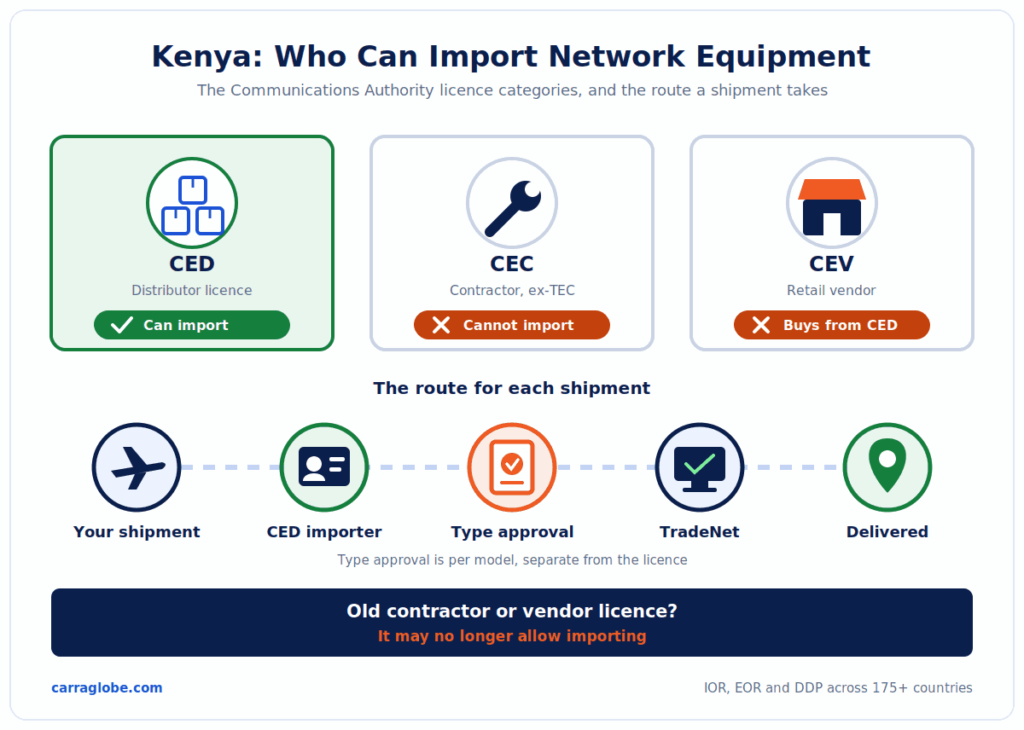
Who needs a Kenya CED licence
Any entity seeking to import and wholesale distribute communications equipment. That is how the CA’s public notice frames it. The market structure sets out no separate import route for network operators bringing in equipment only for their own networks, so an operator in that position should confirm its treatment with the CA before shipping.
Existing licences change in different ways. Telecommunications Equipment Contractor (TEC) holders move automatically to the new Communications Equipment Contractor (CEC) licence, which does not allow importing, so those that want to import must apply for a CED licence. Retail vendors fall under the Communications Equipment Vendor (CEV) class licence and must buy type-approved equipment from CED holders.
Which equipment counts? The CA’s own type approval application form lists networking equipment such as routers, switches and modems as a category, alongside terminal equipment and radio transceivers. Servers and other specialised kit are not named, so check each model’s function with the CA or your licensed importer before you ship.
How the CED licence links to type approval and TradeNet
For resale, the licence and type approval are separate requirements. The CA’s notice says a CED licence is needed to import, to have equipment type approved and to clear it in TradeNet, Kenya’s electronic single window. A CED licence does not replace type approval, and type approval does not by itself authorise importing.
The supply chain must be documented. The licence terms require the holder to keep official documents showing it is the manufacturer, an authorised distributor, or an accredited local distributor or reseller for each brand it sells. Gaps there usually surface as a customs hold on IT shipments.
The licence terms that affect you as a supplier.
| Licence term | What the CA’s terms say |
|---|---|
| Duration | 15 years from the effective date, unless revoked |
| Application and initial fees | KSh 5,000 to apply and KSh 250,000 on grant, under the market structure |
| Annual operating fee | 0.4% of audited annual gross revenue from licensed services or KSh 120,000, whichever is higher, due on 1 July |
| Equipment | Only type-approved equipment may be imported and distributed |
| Warranty and returns | At least a one-year warranty and a 14-day return window (licence terms, conditions 6.3 and 5.5) |
| Records | Kept for at least five years, including models, serial numbers and quantities (condition 7.3) |
| Reporting | A compliance report by 15 July for the year to 30 June |
| Transfer | No assignment or transfer without the CA’s prior written consent |
| Installation | Not covered, since installation and maintenance fall outside the CED licence |
Why foreign sellers get stuck
The licence sits with the entity the CA has licensed. It cannot be transferred without the CA’s consent, so a foreign seller cannot simply rely on another party’s licence. Confirm who will be the importer and that its licence covers the arrangement. It is the same problem covered in our guide to how you import IT equipment without a local entity and in our guide on the importer of record for technology resellers.
Telecom kit raises the stakes. Radio equipment and products with strong encryption bring their own checks, which our pages on importer of record for telecom equipment and encryption import questions cover, while your HS code for routers and switches shapes how customs treats the entry.
Shipping routers, modems, phones or network kit into Kenya? Send Carra Globe the model list, HS codes and any type approval references, and we will confirm the licensing and approval route before you book freight. Request a Kenya import check.
A five-step Kenya CED licence check
- Confirm your importer holds a CED licence that covers the intended import and distribution, not only a contractor or vendor licence.
- Check type approval for every model, or plan the application through the licensed importer.
- Confirm the CED holder can evidence the supply chain, including your status as manufacturer, authorised distributor or accredited reseller for the brand, and a letter of agency where the CA asks for one.
- Align the paperwork so model numbers, serials and quantities match across invoice, packing list and approvals.
- Model the costs, including warranty and after-sales support the importer must provide, in your landed cost.
How Carra Globe handles Kenya shipments
Our Kenyan partner holds a CED licence, and we confirm the route before accepting a shipment. Carra Globe acts as importer of record for IT, network and telecom hardware entering Kenya, and we have shipped hardware into Kenya before. A licence does not make every model type approved, so we check approvals for each shipment.
For project deliveries, see how we handle IT rollouts with Kenya pre-cleared customs. Where equipment later leaves the country, Carra Globe can act as exporter of record, and wider coverage sits on our IOR by country page.
Carra Globe works through importer-side registrations and local importing structures appropriate to the goods and destinations it accepts, its own in some markets and established local structures in others. Approvals falling outside the available structure are flagged before a delivery date is agreed.
If you are shipping hardware into Kenya, send us the model list, HS codes, type approval status, delivery address and the date the goods need to arrive. Reach us at info@carraglobe.com
Kenya · CED Licence · Importer Of Record
Send the model list. We will tell you how it enters Kenya under the new licence.
Most Kenya delays on network and telecom hardware now start with an importer whose old licence no longer covers import, or a model with no type approval. So the useful conversation is who holds the CED licence, which models need type approval, and how the entry clears in TradeNet. Where something sits outside the structure available, you hear that before a delivery date is agreed.
- IOR for system integrators
- Global IOR for technology OEMs
- When the customer will not be IOR
- How to verify an IOR provider
- What an importer of record costs
- DDP or importer of record
- How to compare DDP quotes
- Importing used and refurbished IT kit
- Lithium battery customs clearance
- HS code for servers
- SONCAP certification in Nigeria
- Customs clearance in Ghana
- Mauritius as an African IT gateway
- SASO 3114 in Saudi Arabia
- Data centre server and rack deployments
Free tools HS Code Finder Volumetric Weight Calculator Pallet Calculator
Shipping routers, modems, phones or network kit into Kenya? Send the model numbers with HS codes and any type approval references, the delivery address and your arrival date. We will come back on the licence, the approvals and who acts as importer.
Check my Kenya shipmentFrequently asked questions
What is the Kenya CED licence?
A Communications Equipment Distributor licence from the Communications Authority of Kenya, required to import and wholesale distribute communications equipment under the market structure gazetted on 6 March 2026.
Can a TEC or Vendor licence holder still import?
Not under the old licence. TEC holders move automatically to the CEC category, which does not allow importing, and vendors buy from CED holders. Either must obtain a CED licence to import.
Do I need a CED licence for type approval?
For importing and wholesale distribution, the CA’s notice links the CED licence to type approval and TradeNet clearance, but the licence is not product approval. Each model still needs type approval.
Can a foreign company import telecom equipment into Kenya?
Usually through a CED-licensed importer. The licence cannot be transferred without the CA’s prior written consent, so confirm the importer and its licence before dispatch.
How much does the CED licence cost each year?
After a KSh 5,000 application fee and KSh 250,000 initial fee, the annual fee is 0.4% of audited gross revenue from licensed services or KSh 120,000, whichever is higher.
Does the CED licence cover servers and switches?
Switches are listed as networking equipment on the CA’s type approval form. Servers are not named, so assess each model against the CA’s definitions and its function.
Adjacent ground: what an importer of record does, multi-country IT equipment rollouts and importer of record for small shipments.
Sources and verification
Checked against Communications Authority of Kenya publications on 20 October 2026.
- The notice. Communications Authority of Kenya public notice on importation and distribution of communications equipment, requiring the CED licence for import, type approval and TradeNet clearance.
- The licence terms. Communications Authority of Kenya licence terms for Communications Equipment Distributors, covering duration, fees, equipment, warranty, records, reporting and transfer.
- The legal basis. The Revised Telecommunications Market Structure of June 2026, including CED, CEC and CEV scope and fees, under Gazette Notice No. 3335 of 6 March 2026 and the Kenya Information and Communications Act, Cap. 411A, with the CA’s transitional provisions for existing licensees.
- Type approval. The CA type approval application form of June 2025, listing networking equipment such as routers, switches and modems as a category.
- Verification note. Licence categories, fees and type approval scope may change, so check the CA’s current position before relying on this guide. Nothing here is advice on your shipments.
Disclaimer: This guide is for informational purposes only and does not constitute legal, customs or licensing advice. Licensing and type approval requirements depend on the equipment and the parties involved. The position described is as at 20 October 2026. Confirm the current position with the Communications Authority of Kenya or your importer of record before shipping.