
There is an assumption buried in most importer of record arrangements, and it is rarely said out loud. The assumption is that once another company is named on the declaration, the customs exposure moves to them. It is an understandable reading, and in the European Union it is half right. The half it gets wrong is the expensive one.
The short version. In the EU the declarant must be established in the customs territory of the Union, subject to stated exceptions. A company without that standing needs someone who has it, usually an EU-established indirect representative. On release for free circulation the Code makes that declarant a debtor, and the person represented a debtor too. Duty and import VAT do not travel together. The Court of Justice has held Article 77(3) covers duty but not, by itself, import VAT. Appointing an importer of record does not move the debt off you. It decides who stands beside you, and on which part.
Carra Globe provides importer of record, exporter of record, delivered duty paid and freight forwarding services, so we have a commercial interest in your answer. What follows is written to be usable whether or not you ever speak to us.
Why someone else has to declare your goods at all
The declarant has to be established in the EU. The Union Customs Code says so directly, then lists the exceptions, which are transit and temporary admission, occasional declarations where customs consider it justified, and certain neighbouring-country declarants on a reciprocal basis. Release for free circulation, which is what an ordinary import is, is not on that list.
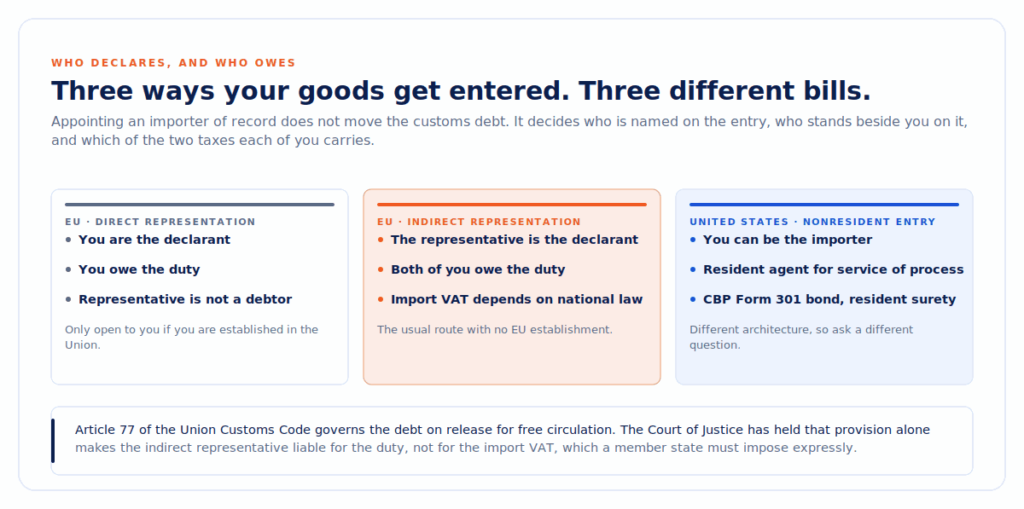
So someone else declares, and the way they do it matters. The Code offers two forms of representation. A direct representative acts in the name of and on behalf of another person. An indirect representative acts in its own name but on behalf of another person. Representatives must themselves be established in the Union, subject to the exception in that article.
That difference is the hinge. In indirect representation the representative acts in its own name, so it is the declarant and carries the establishment requirement. You are not the declarant, so you do not. That is precisely why the arrangement works for a company with no entity in the market, and precisely why the liability question has a second half.
The European Commission describes the same structure in its administrative guidance on tariff rulings. A non-EU holder, it says, will not be able to lodge a declaration himself or by means of a direct representative, and needs an indirect representative established in the EU, who is then the declarant while the holder is considered the importer. That passage is written about BTI holders rather than as a general definition, and the guidance is administrative rather than legislation. What it describes is nonetheless the arrangement the market calls an importer of record.
Importer of record is a commercial term rather than one the Code uses, and whether a shipment needs this route depends on the procedure, the goods and the member state. Treat it as the common answer rather than the only one, and see importing into a new country without setting up a legal entity for the options.
The rule is not universal, and assuming it is will cost you time in the wrong market. In the United States a nonresident corporation may enter merchandise for consumption, provided it has a resident agent authorised to accept service of process in the state where the port of entry is located, or in the state the filing originates from where the entry is filed remotely, and files a bond on CBP Form 301 with a resident corporate surety. Different architecture, different question to ask, which is why we keep IT hardware import rules by country separately.
The sentence that decides who pays
Article 77 of the Union Customs Code governs the customs debt arising on release for free circulation and on temporary admission with partial relief from import duty. Other customs debts arise under other provisions. For an ordinary import it is the first of those that applies, and the Code states that the declarant shall be the debtor. It then adds a second sentence that most importer of record discussions never reach. In the event of indirect representation, the person on whose behalf the customs declaration is made shall also be a debtor.
Read that against the structure above. Where an entry runs on EU indirect representation and a customs debt arises under Article 77, the declarant is a debtor and you, as the person on whose behalf it was made, are a debtor too. The liability is not transferred. It is extended. That only applies where your provider is itself acting as the indirect representative and declarant, which a commercial label does not establish on its own, and other models and other countries can produce different results.
Then the two taxes part company. In Case C-714/20 the Court of Justice held that under Article 77(3) alone the indirect customs representative is liable only for the customs duties payable on the goods which he or she has declared to customs, and not also for the import value added tax on those goods.
That is not a blanket exemption. A member state may still impose joint VAT liability under the VAT Directive, but the Court held it cannot be accepted where there are no national provisions explicitly and unequivocally designating the representative as liable. The duty position comes from the Code. The VAT position depends on the member state of import, and import VAT can exceed the duty. We have set out the wider position in import VAT and the importer of record.
None of this argues against using an importer of record. Where you have no entity, the alternative is not importing. It argues about which one, because what you are buying is not a name on a form. You are buying the quality of the decisions that company makes while standing on a debt you share, which is the difference set out in paper IOR versus operational IOR. Which company in a chain should be named is a separate question, covered in who is liable when a reseller imports.
What that shared liability is actually worth
Tariff classification is one decision that can move that debt sharply on IT hardware. The disputes below come from tribunal decisions, a court judgment and a customs adjudication order rather than vendor commentary. Three are Indian and one European, so they show what classification risk is worth rather than establish any EU rule on who owes the debt.
Nil duty to fifteen percent, on laptop display panels. In Customs Appeal No. 50135 of 2024, decided on 19 August 2026, the Principal Bench of India’s Customs, Excise and Service Tax Appellate Tribunal considered Innolux replacement panels declared under 8473 30 99 as parts and accessories of computers, a line carrying nil basic customs duty. The tribunal held the goods classifiable under heading 8524 as flat panel display modules, attracting basic customs duty at 15 percent. The appeal was dismissed and the differential duty was confirmed across one live consignment and 16 earlier ones.
A 34.89 crore rupee demand set aside. On 21 January 2026 the Chennai bench of the same tribunal went the other way for Hitevision Tech India, on imports between 9 August 2023 and 19 March 2024. Interactive flat panels with an inbuilt CPU had been declared under 8471 49 00 and parts under 8473 30 99. Customs proposed 8528 59 00 for the panels and 8529 90 90 for the parts, and raised a differential duty demand of 34,89,01,972 rupees with interest, fines and penalties.
The tribunal set the order aside, holding that the revenue had not discharged its burden. The goods remained classified under heading 8471 and their parts under heading 8473 at the four-digit level, as self-assessed, with consequential relief to follow.
Those two cases are not the same dispute twice. The products differ and so do the questions. What they share is the method, since each turned on what the goods actually were against the section and chapter notes, rather than on the code the importer had chosen. An importer of record that classifies by copying the supplier’s invoice skips exactly that work, on a debt you share.
Fourteen points, in the European Union. In Panasonic Italia and Others, Case C-472/12, decided 17 July 2014, importers declared 106.6 cm plasma screens under 8471 60 90 as exempt, while the Italian authority applied 8528 21 90 at 14 percent. The Court did not classify the screens itself. It held they fall under 8471 60 90 if used solely or mainly in an automatic data-processing system and under 8528 21 90 if not, leaving that test to the national court.
And duty is not the only thing keyed to the code. In Order-in-Original No. MUN-CUSTM-000-COM-12-23-24, dated 4 September 2023, the Commissioner of Customs at Mundra examined 96 bills of entry filed by GTPL Broadband between 2017 and 2021, with an assessable value of 76,38,74,823 rupees. Optical network terminals had been declared under 85176950 with a nil duty exemption claimed. The department placed them under 85176290 instead and pointed to later notifications that had removed those goods from the exemption, with duty of 10 or 20 percent in play. An exemption can be lost by classification alone.
Three of those four sit across the same divide. Heading 8471 covers automatic data-processing machines and units of them and 8473 their parts, while 8524 covers flat panel display modules and 8528 monitors. Separately imported laptop panels, interactive panels with an inbuilt CPU and plasma screens were each argued across that divide. They are not interchangeable products or precedents, and the tests differed, from chapter notes through to whether a screen is used solely or mainly with a data-processing system.
Only the Mundra case sits elsewhere, inside heading 8517. If you move servers, displays, networking hardware or accelerator cards, the heading follows the technical specification rather than the product name, and the wider map of HS codes for electronics and tech equipment shows which headings matter for which goods.
Our HS Code Finder will give you a candidate code, and like every such tool it tells you to verify the result against the applicable national tariff. The sections below are about how that verification is actually done, and about who carries it if it is skipped.
How to take the classification risk off the table
A binding ruling is the formal way to settle a code before you rely on it. The European Commission describes Binding Tariff Information as a legal decision issued by EU countries’ customs authorities on the tariff classification of a product. A BTI is generally valid for three years throughout the EU and is binding on all EU customs administrations and the holder of the decision. It covers the goods described in the decision, and it can be annulled, revoked or otherwise cease to be valid before the three years are up.
Great Britain runs an Advance Tariff Ruling instead, which HMRC describes as a legally binding decision on the commodity code to use, and answers in 30 to 120 days.
Three features of these rulings matter specifically when an importer of record is involved.
- A ruling has a named holder, and it is not transferable. HMRC states that the decision names the person legally entitled to use it and that decisions are non-transferable. A ruling held by your supplier is not automatically yours to rely on, and one held by an importer of record you later replace does not move with you. It may still be useful evidence of how comparable goods have been treated.
- You may be able to obtain one without an EU-established company. The Commission’s guidance states that BTI applications may also be received from economic operators established outside the EU, provided they are registered with customs, which means holding an EU EORI. If that step is unfamiliar, start with what an EORI number is and who needs one.
- Your declarant then has to use it. The guidance describes a legal obligation on traders to declare their BTI decisions and use them, and states that an indirect representative is bound to indicate the reference number of the BTI decision held by his client. For that to happen in practice the decision has to be valid, it has to cover the goods being declared, and your representative has to be given the reference, so confirm the filing workflow rather than assuming it.
That combination is a strong position for a company importing without an entity. Holding the ruling in your own name reduces dependence on any one provider, because replacing that provider does not itself move the decision to the new one. The classification then has a formal decision behind it rather than a code chosen by whoever happens to be filing. It is not a cure for every customs risk, and it applies only to the goods the decision describes, for as long as it remains valid.
The timing is unforgiving. HMRC’s guidance says to apply before all customs procedures for the goods are completed, because decisions cannot be made retrospectively. Once the entry is filed you are in correction territory instead, which runs on a different and narrower set of options set out in what to do about a wrong HS code on an invoice, with the consequences of leaving it in the cost of incorrect HS codes on high-tech imports.
What to ask before you appoint an importer of record
If the entry runs on indirect representation and a customs debt arises, you are a debtor alongside your provider. That changes the questions worth asking. These are the ones that actually separate providers, and they are more useful than a rate card.
- Who classifies, and from what? A provider that classifies from the technical specification is doing the work. One that copies the code off the commercial invoice is passing your supplier’s guess onto a declaration you are a debtor on.
- Will you cite a ruling I hold? In the EU an indirect representative is bound to indicate the reference number of a BTI held by its client. A provider that cannot explain how that works in its filing process has not met the situation before.
- Are you the declarant, or are you introducing one? The answer determines who is actually on the entry. The distinction between the roles is covered in importer of record versus customs broker and in freight forwarder versus importer of record.
- What happens to my position if you fail? Shared liability outlives a supplier relationship, which is the uncomfortable scenario we wrote up in what happens when an IOR provider goes bankrupt.
- What will you refuse? A provider that accepts everything has not read the restrictions. Our view on selecting against that is in how to choose an importer of record.
How Carra Globe works with this
We take the classification question seriously because of the rule above, not in spite of it. When Carra Globe is the declarant, the duty exposure we create is exposure you carry with us, and that is the right incentive for both sides.
Carra Globe works through importer-side registrations and local importing structures appropriate to the goods and destinations it accepts, its own in some markets and established local structures in others, and approvals falling outside the available structure are flagged before a delivery date is agreed. In practice that means classifying from the technical specification per model rather than the product name, telling you when a heading boundary is genuinely arguable, and saying when a ruling is worth the lead time before a date is promised rather than after.
IT hardware is the core of the business, from data centre equipment through to AI servers and GPU clusters, across the markets listed in IOR by country.
Send us the destination, the lane and the full technical specification per model, and we will come back on who can lawfully be named as importer there, what the classification turns on, and whether a ruling is worth obtaining before the goods move. Reach us at info@carraglobe.com.
Indirect Representation · EU Customs Debt
If you are a debtor either way, the only question left is who stands beside you.
Appointing an importer of record does not move the customs debt. On release for free circulation the Code makes the declarant a debtor and the person represented a debtor too. So the thing you are actually buying is the quality of the decisions made on an entry you are already on. We classify from the technical specification per model rather than the commercial invoice, say plainly when a heading is arguable, and flag approvals that fall outside the available structure before a delivery date is agreed.
- Importer of record in Germany
- Importer of record in the Netherlands
- Importer of record in France
- Importer of record in Ireland
- Importer of record in Spain
- Importer of record in Italy
- Importer of record in Belgium
- Importing into Germany with no entity
- EU dual-use export controls
- What an importer of record is
- How to verify an IOR provider
- When the customer will not be IOR
- Exporter of record in Germany
- Exporter of record in the Netherlands
- EOR by country
Free tools HS Code Finder Volumetric Weight Calculator Pallet Calculator
Shipping into the EU without an entity there? Send the destination, the lane and the full technical specification per model. We will come back on who can lawfully be named as importer, what the classification turns on, and whether a binding ruling is worth obtaining before the goods move.
Check my EU routingFrequently asked questions
Does appointing an importer of record remove my liability?
Not where EU indirect representation is used. The Code makes the declarant a debtor and states that the person on whose behalf the declaration is made is also a debtor for that customs debt.
Can a company outside the EU declare its own goods?
Usually not for free circulation. The Code requires the declarant to be established in the Union, with exceptions covering transit, temporary admission and certain occasional declarations.
Can a non-US company be the importer of record in the United States?
A nonresident corporation may enter goods where it has a resident agent for service of process in the port of entry state, and files a CBP Form 301 bond with resident corporate surety.
Who is responsible if my importer of record uses the wrong HS code?
Under EU indirect representation both the declarant and the person represented may be debtors for the resulting customs debt. Fault for the error itself, and any penalty, depends on the facts and the applicable law.
Is an indirect customs representative liable for import VAT?
Article 77(3) alone does not make it liable for import VAT, only for the duty. A member state may impose that liability, but national provisions must expressly and unequivocally identify the representative as liable.
Can I hold a BTI if I have no EU company?
Yes. Commission guidance states applications may be received from operators established outside the EU where they are registered with customs, meaning they hold an EU EORI number.
Does my importer of record have to use my ruling?
In the EU an indirect representative is bound to indicate the reference number of the BTI decision held by its client, and traders are under an obligation to declare and use their decisions.
Adjacent ground: importer of record in the UK, the 2026 CARM liability changes in Canada and a power of attorney for customs.
Sources and verification
Every legal rule below comes from the legislation or the issuing authority’s own guidance, and every case was read in the decision or order itself rather than in press coverage. All were checked on 12 October 2026.
- Representation and the customs debt: Regulation (EU) No 952/2013, consolidated. Article 18 for the two forms of representation, the requirement that a representative be established in the Union, and the waiver where it acts for persons not required to be established. Article 77 for the declarant being the debtor and the person represented also being a debtor in indirect representation.
- Who may be the declarant: Article 170, for the declarant having to be established in the customs territory of the Union, and the derogations covering transit and temporary admission, occasional declarations, and certain neighbouring-country declarants.
- Duty against import VAT: U.I. (Indirect customs representative), Case C-714/20, for Article 77(3) alone making the representative liable only for customs duties and not import VAT, and for joint VAT liability requiring explicit national provisions.
- The non-EU holder’s position: European Commission, Administrative Guidance on the Binding Tariff Information Process, for the indirect representative being the declarant while the holder is the importer, applications being receivable from operators outside the EU where registered with customs, and the representative being bound to indicate the client’s BTI reference. Administrative material, not legislation.
- EU Binding Tariff Information: European Commission, EU Binding Tariff Information, for the definition, three year validity across the EU, and binding effect on all EU customs administrations and the holder.
- Great Britain Advance Tariff Ruling: HMRC, Apply for an Advance Tariff Ruling, for the legally binding decision, the named holder, non-transferability and the 30 to 120 day window. The instruction to apply before customs procedures are completed, because decisions cannot be made retrospectively, is in HMRC’s BTI guidance.
- United States nonresident entry: 19 CFR 141.18, for the resident agent authorised to accept service of process in the port of entry state, the alternative where an entry is filed remotely under subpart E of part 143, and the CBP Form 301 bond with resident corporate surety.
- Laptop display panels: CESTAT, Principal Bench, New Delhi, Customs Appeal No. 50135 of 2024, decided 19 August 2026. The declared 8473 30 99 at nil basic customs duty, the holding that the goods fall under heading 8524 at 15 percent, and the appeal dismissed across 17 consignments. The order is inconsistent between two subheadings within 8524, so this article cites the heading only.
- Interactive flat panels: CESTAT Chennai, Hitevision Tech India Pvt. Ltd. v Commissioner of Customs, Chennai II, Customs Appeal No. 40829 of 2024, Final Order No. 40125/2026, decided 21 January 2026. The declared 8471 49 00 and 8473 30 99, the proposed 8528 59 00 and 8529 90 90, the demand of 34,89,01,972 rupees, the order set aside, and classification remaining at headings 8471 and 8473 at four-digit level.
- Plasma displays: Panasonic Italia and Others, Case C-472/12, 17 July 2014, for 8471 60 90 as exempt against 8528 21 90 at 14 percent, and the solely or mainly test left to the national court.
- Optical networking: Custom House Mundra, Order-in-Original No. MUN-CUSTM-000-COM-12-23-24, 4 September 2023, for the 96 bills of entry, the assessable value, the declared 85176950 with a nil duty exemption claim, the 85176290 analysis and the 10 or 20 percent duty in issue. The confirmed differential duty figure sits beyond the readable portion of that order and is not stated here.
- Tariff heading scopes: UK Integrated Online Tariff, for the descriptions of headings 8471, 8473, 8517, 8524 and 8528.
- Scope note. The three Indian decisions are jurisdiction-specific. They show how far a duty outcome can turn on product facts and national tariff interpretation, and establish no EU rule on representation or liability. Two further cases were excluded, one because the tariff codes were never disclosed publicly and its headline figure included penalties, the other because the decision record could not be independently confirmed. Nothing here is advice on your goods. Confirm the position with the customs authority or a qualified adviser before relying on it.
Disclaimer: This guide is for informational purposes only and does not constitute legal, customs or trade compliance advice. Customs representation, liability for customs debt, tariff classification and ruling procedures depend on the specific product, its technical specification, the destination and the date, and they change. The position described is as at 12 October 2026. Confirm the current position with the competent authority or a qualified adviser before acting.