
The standard EU customs duty on a laptop is zero, and that number misleads more shippers than any other. When you are shipping laptops to Europe from outside the EU, the cost and the delays sit elsewhere, in import VAT, the customs declaration, EORI details and air-freight battery rules. Carra Globe has handled more than 130 laptop shipments to EU countries, from a single box to enterprise and manufacturing volumes. Where customs clearance was needed and those points were settled first, the laptops cleared the same day or the next working day. When something was missing, release took four to six days.
The short version. Laptops under CN code 8471 30 00 carry a 0% standard EU customs duty, but import VAT applies at the rate of the member state where the goods are imported. EU customs generally expects the declarant to be established in the EU, so a company without an EU entity usually ships through its own EU company, a customs representative or an importer of record. For business laptops, arrange the importer and VAT treatment in advance rather than relying on the recipient to pay at the door, give every laptop a supportable value, and confirm the battery rules with the carrier before booking.
Carra Globe provides importer of record, exporter of record, delivered duty paid and freight forwarding services, so we have a commercial interest in your answer. What follows is written to be usable whether or not you ever speak to us.
What we see on laptop shipments into Europe
Same day to one working day, when the paperwork is right. Our laptop shipments go mostly to the Netherlands, Germany and France, and they start from the US, the UK, Asia and other EU countries. The senders range from IT teams equipping staff to resellers, individuals and data centres. That clearance time applies to shipments needing customs clearance and is our experience, not a customs service standard, and an inspection or customs query can still add time.
Four recurring gaps cause most of the holds we see. When customs or a carrier finds one, release has taken four to six days rather than one. Each is covered below, with how to avoid it.
Laptop imports into the EU at a glance
Four of these points change in 2026. The EUR 3 low-value duty arrived on 1 July, the EUR 2 handling fee and mandatory product identifiers in e-commerce declarations both start on 1 November, and IATA made the 30% charge limit mandatory for spare batteries packed with equipment from 1 January. A new Union Customs Code, adopted in September 2026, generally applies from 21 September 2027, with some provisions earlier.
| Point | Position as at October 2026 |
|---|---|
| Customs duty | 0% third-country rate on CN 8471 30 00 portable computers |
| Low-value duty | EUR 3 per item, counted by tariff classification rather than units, on goods sold in distance sales in consignments with an intrinsic value up to EUR 150, whatever the VAT scheme, 1 July 2026 to 1 July 2028 |
| Handling fee | EUR 2 per item on goods sold in distance sales, from 1 November 2026, with no EUR 150 limit in the rule |
| Import VAT | Standard rate of the member state of import, at least 15% under the VAT Directive |
| Who can declare | A declarant established in the EU, with narrow exceptions |
| EORI number | Required for the operator carrying out the customs activity, so confirm whose EORI the declaration uses |
| Battery inside the laptop | State of charge at or below 30% strongly recommended for air |
| Spare batteries in the box | Different packing rules, with a 30% maximum in specified cases. Confirm with the carrier |
| Clearance on our shipments | Same day to one working day when documents are complete |
| Laptops coming back | Possible duty relief if returned within three years and conditions are met |
Who should be the importer
The declarant needs to be established in the EU. The current Union Customs Code says so in Article 170, subject to specified exceptions such as transit, temporary admission, occasional declarations customs accepts as justified and some neighbouring-country cases. A company outside the EU therefore cannot usually import a steady flow of laptops in its own name. The importer, the declarant and a customs representative are related but separate roles. That leaves four possible arrangements, and they do not create the same legal role or VAT outcome.
- The recipient. If no business importer is arranged, the courier will often seek the import VAT and its fees from the person receiving the laptop. A private recipient generally cannot reclaim import VAT as input tax, may have no authority to pay it, and may refuse the parcel.
- Your own EU company. An EU entity with an EORI number can import, and a VAT-registered business may recover import VAT where it meets the normal input-tax conditions and holds the right documents.
- An importer of record. Where you have no EU entity, an importer of record service can provide the EU importing structure. The set-up decides who appears on the declaration, who carries the customs obligations and how import VAT is handled.
- A customs representative. An indirect representative acts in its own name and can share liability for the customs debt, as our guide to indirect representation, duty and import VAT explains. A direct representative acts in your name, so it does not remove the EU-establishment requirement on the declarant.
Decide this before the airway bill is cut. Changing the importer after the laptop lands can mean reworking the paperwork and a delay. For the bigger picture, see what an importer of record does and how the Union Customs Code reform will change the importer definition.
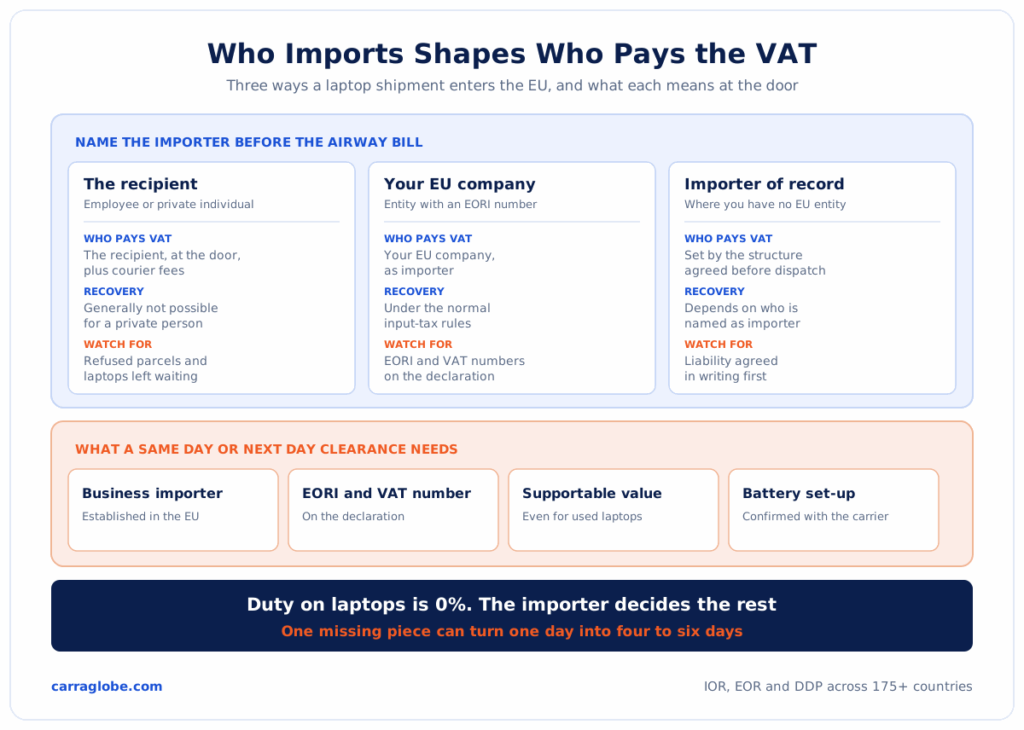
Duty is zero, VAT is not
The standard duty rate for laptops is 0%. The EU’s TARIC database shows a 0% third-country rate on CN code 8471 30 00 for portable computers, although separate duties and fees can apply in particular cases. Check TARIC for the exact code and origin, because other measures can apply to particular goods or consignments. Accessories shipped alongside, such as docking stations, monitors or chargers, may classify under different codes with their own rates, so check each line. Our guide to the HS 8471 heading covers how computers are classified.
The 2026 low-value duty can touch cheaper units. From 1 July 2026 until 1 July 2028, Council Regulation (EU) 2026/382 sets a temporary EUR 3 customs duty on goods sold in distance sales in consignments with an intrinsic value up to EUR 150. It reaches IOSS imports directly and other distance sales through a redefined “postal consignment” that does not depend on using the post, so the Commission’s guidance applies it whatever the VAT scheme. The same regulation abolished the old EUR 150 duty relief, so other low-value goods now pay their normal tariff rate.
It is counted per item, not per unit. The count is based on tariff classification rather than quantity, so five identical laptops under the same classification generally attract one charge, not five. A company laptop sent to staff without a sale is not a distance sale, so it generally falls outside the duty, but confirm the treatment with your declarant.
The EUR 150 is per consignment. The threshold applies to the whole consignment’s value, not each laptop, and most business laptop consignments exceed it.
The EUR 150 VAT limit is a separate test. For online sales to consumers, the Import One-Stop Shop lets the seller charge EU VAT at checkout on consignments worth up to EUR 150, and the goods then enter free of import VAT when a valid IOSS number is declared. Above EUR 150, IOSS cannot be used, so import VAT falls due at the border in the usual way. The VAT limit and the EUR 3 duty limit share a number but are different rules. From 1 July 2028, sellers outside IOSS who make these sales become liable for the VAT in each destination country.
A handling fee follows from November, with a wider reach. From 1 November 2026, customs collect a EUR 2 Union handling fee per item on goods released for free circulation that were sold in distance sales, as set by Delegated Regulation (EU) 2026/2152, payable by the customs debtor, who is often also the declarant. The law defines an item as goods sharing the same tariff classification, description and, where required, origin, but the count follows how the goods are declared. Dutch Customs’ published procedure, for example, charges it per declaration line, so confirm the treatment with your declarant.
It reaches online sales of any value. Unlike the EUR 3 duty, the rule sets no EUR 150 ceiling, so retailers selling laptops online to EU customers should cost it in at any value. Company laptops sent to staff without a sale are generally not distance sales. From the same date, product identifiers become mandatory on each line of e-commerce import declarations made under the specified VAT arrangements, so online sellers should make sure each laptop’s model identifier reaches their declarant before dispatch. Our guide to the EU de minimis changes in 2026 covers who it hits.
Import VAT is usually the largest border charge. The member state of import charges its standard rate (at least 15%) on the customs value plus any duty, other charges such as the EUR 2 handling fee where it applies, and transport and insurance to the first destination in that country, or to a later EU destination already known at import. For a business that can recover it, the VAT is a cash-flow cost rather than a final one, and who can recover it depends on the import arrangement. Our guide to import VAT and the importer of record explains more.
Four gaps that hold laptops at the border
A private recipient named as importer. This is the most avoidable hold. The courier asks the recipient for VAT, they cannot or will not pay, and the parcel sits. Arranging a business importer in advance reduces that risk a great deal, as our guide to when the recipient will not be the importer of record explains.
No value, or the wrong one. Company-owned, redeployed and used laptops often travel with no sale behind them, and a pro forma invoice marked “no commercial value” invites questions. Customs needs a value set under the customs valuation rules and backed by evidence, such as the purchase price or records supporting another permitted method. Our guide to an importer of record when there is no sale explains the options.
Battery rules for air freight. In air-freight terms, a laptop is lithium-ion batteries contained in equipment. IATA’s 2026 guidance recommends a state of charge at or below 30% for a battery installed in the laptop. Spare batteries packed in the same box follow a different packing instruction, which sets a 30% maximum in specified cases. Damaged or defective batteries face strict limits and are generally not accepted by air unless an exception or approval applies, so confirm the configuration with the carrier, and see our guide to lithium battery customs clearance.
A missing EORI or VAT number. Businesses dealing with EU customs need an EORI number, and the VAT details required depend on the import arrangement and the member state. Without the right identifiers, the shipment waits, so confirm them before dispatch. Our explainer on what an EORI number is sets out who needs one.
Shipping laptops into one or several EU countries? Send Carra Globe the model list, quantities, values and delivery addresses, and we will confirm the importer, documents and battery set-up before anything is booked. Request a laptop shipment check.
Between EU countries, and into the UK, Switzerland or Norway
Inside the EU, there is generally no customs declaration. Laptops already in free circulation move between member states without an import declaration, although VAT rules on moving business goods across borders still apply, so check them with your VAT adviser. Our guide to tracking IT shipments across the EU helps with multi-country deliveries.
Choose the country of import with care. Import VAT falls due where the laptops are released into free circulation, so clearing them in the Netherlands for staff in France leaves Dutch VAT to handle. The VAT Directive allows an import VAT exemption when goods move straight on to another member state, often called customs procedure 42. It only works where the onward movement is itself a VAT-exempt intra-EU supply or transfer and the importer gives the required VAT numbers at import. That rarely suits deliveries to private recipients, so clearing in each delivery country is often simpler.
The UK, Switzerland and Norway are separate customs territories. A laptop crossing into any of them needs its own import declaration and its own VAT treatment. Switzerland abolished industrial tariffs on 1 January 2024, so laptops generally enter without duty, but Swiss import VAT still applies. Norway sits in the European Economic Area but outside the EU customs union. See our pages on importer of record in the UK and importer of record in Switzerland.
Northern Ireland is a special case. Under the Windsor Framework, EU VAT rules for goods apply there, goods move between Northern Ireland and the EU without declarations, and laptops arriving from outside the UK and EU need their own declaration and tariff treatment.
Selling the laptops adds product compliance
Selling brings product law, not just customs. Under EU product law, the importer is the business established in the EU that places a laptop from outside the EU on the market. Distributors further down the chain have lighter checks of their own. That role brings CE marking checks, and producer registration for electrical waste and batteries may be needed in each member state, depending on the national scheme.
Customs and product roles differ. Acting as customs importer of record does not by itself make a business the product-law importer or the registered producer, so those roles need checking separately. Our guides cover CE marking obligations for importers and WEEE producer obligations, including batteries.
When the laptops come back
Plan the return leg at the start. A laptop leaving the EU at the end of a contract or a project is an export, and the country it returns to applies its own rules. Laptops that left the EU as Union goods and come back within three years may qualify for returned goods relief from import duty under Article 203 of the Union Customs Code, provided they meet its conditions, including their state on return. Duty relief does not settle the import VAT, which has its own conditions.
Keep the original export records. They support any relief claim. See our guide to returned goods and reverse logistics.
A six-point check before you book
- Name a business importer established in the EU, never a private recipient by default.
- Agree the identifiers with whoever prepares the declaration, including whose EORI is used and which VAT details the set-up needs.
- Classify every line, laptops under 8471 30 00 and each accessory under its own code.
- Give each laptop a supportable value, especially used or company-owned units.
- Check the battery set-up with the carrier, including any spares in the box.
- Plan the return leg and keep export records for any laptop that may come back.
How Carra Globe handles laptop shipments into Europe
We settle the importer and documents before the laptops move. Carra Globe can act as importer of record in every EU member state, or work alongside your own EU company where you have one, depending on the shipment. Country detail is on our pages for the Netherlands and Germany, and we handle doorstep delivery through white glove delivery.
Carra Globe works through importer-side registrations and local importing structures appropriate to the goods and destinations it accepts, its own in some markets and established local structures in others. Approvals falling outside the available structure are flagged before a delivery date is agreed.
When laptops later leave the EU, we can act as exporter of record, and our IOR by country page covers 175+ countries. For a quote, send your draft commercial invoice with models, quantities and values, the battery details, total weight and dimensions, and each delivery address. Reach us at info@carraglobe.com.
European Union · Laptops · Importer Of Record
Send the model list and delivery addresses. We will tell you how your laptops clear in each EU country before they ship.
Laptops entering the EU carry no customs duty, but the importer, VAT, value and battery set-up decide whether they clear the same day or wait. So the useful conversation is who stands as importer in each country, what value each laptop carries and how the batteries travel. Where something sits outside the structure available, you hear that before a delivery date is agreed.
- Importer of record in Belgium
- Germany imports without a local entity
- France import rules for high-tech kit
- Exporter of record in the Netherlands
- Exporter of record in Germany
- EU de minimis, IOR and DDP
- EU parcel tax from July 2026
- EU air cargo security 2026
- HS code for lithium batteries
- EU Cyber Resilience Act for importers
- EU digital product passport
- DDP versus DAP
- Which Incoterm protects tech shipments
- Comparing DDP quotes for IT kit
- Global IOR for technology OEMs
Free tools HS Code Finder Volumetric Weight Calculator Pallet Calculator
Shipping laptops into one or several EU countries? Send the draft invoice with models, quantities and values, the battery details, weights and dimensions, and each delivery address. We will come back on the importer, documents, battery set-up and timing.
Check my laptop shipmentFrequently asked questions
Is there customs duty on laptops in the EU?
The standard rate for laptops under CN code 8471 30 00 is 0%. Import VAT still applies, and low-value distance sales and some accessories can carry other charges.
Who pays import VAT on a laptop shipped to an employee?
The import arrangement decides. With no business importer arranged, couriers often ask the employee to pay at the door, so set up your EU company or an importer of record first.
Can a company outside the EU import laptops in its own name?
Not usually. The Union Customs Code requires the declarant to be established in the EU, apart from narrow exceptions such as occasional declarations customs accepts.
Do I need an EORI number to ship laptops to the EU?
A business dealing with EU customs needs one, but whose EORI appears depends on the declarant and the representation set-up. Confirm it with your importer of record before dispatch.
Can laptops with lithium batteries ship by air?
Yes, as batteries contained in equipment, within dangerous goods and carrier rules. A charge at or below 30% is recommended, and damaged or defective batteries face strict limits unless an exception applies.
Do laptops shipped between EU countries go through customs?
No, laptops already in free circulation move between member states without a customs declaration. VAT rules on moving business goods across borders still apply.
Adjacent ground: DDP versus importer of record and what an importer of record costs.
Sources and verification
Shipment counts, destinations, clearance times and the causes of holds are Carra Globe’s own, covering laptop shipments handled by Carra Globe and its team. Regulatory points were checked against official publications on 28 October 2026.
- Duty. The European Commission’s TARIC measures for CN 8471 30 00, showing the 0% third-country duty, the low-value consignment duty and, from 1 November 2026, the EUR 2 Union handling fee on this code.
- EUR 3 duty law. Council Regulation (EU) 2026/382, Article 2, on the scope and period of the EUR 3 duty.
- Commission guidance. The temporary EUR 3 customs duty and the Union handling fee, guidance for member states and trade, version of 5 October 2026, on distance-sale scope, the redefined postal consignment and the handling fee’s place in the VAT base.
- Low-value duty guidance. The European Commission on the EUR 3 customs duty on low-value parcels, with its per-item example, the Council of the EU on the new customs duty rules for small parcels, adopted on 11 February 2026, the European Commission’s guidance on the temporary flat duty on low-value imports, and its EU customs reform page on the EUR 2 handling fee from 1 November 2026, the Council’s page on modernising the EU customs union, and Delegated Regulation (EU) 2026/2152 setting the fee at EUR 2 per item, and Dutch Customs on the handling fee for e-commerce.
- Who can declare. Regulation (EU) No 952/2013, the Union Customs Code, Article 9 on EORI registration, Article 18 on customs representation, Article 170 on the declarant and Article 203 on returned goods. It stays the general framework until Regulation (EU) 2026/2108, the new Union Customs Code, applies from 21 September 2027, with some provisions earlier.
- EORI. The European Commission on EORI registration and who needs a number.
- Product identifiers. Dutch Customs on including product identifiers in e-commerce declarations from 1 November 2026.
- Product law. Your Europe on general product compliance and the importer’s role.
- VAT. The European Commission on VAT rates under the VAT Directive, including the 15% minimum standard rate, and on the taxable amount for imported goods, and its VAT One Stop Shop page on the import scheme for consignments up to EUR 150.
- Batteries. The IATA lithium battery guidance document for 2026.
- Onward EU deliveries. Article 143(1)(d) and (2) of the VAT Directive, Council Directive 2006/112/EC, on the import VAT exemption for goods moving on to another member state, unchanged in the latest consolidation of 14 April 2025, and Directive (EU) 2025/1539 on the IOSS changes from 1 July 2028.
- Northern Ireland. HM Revenue and Customs on trading and moving goods in and out of Northern Ireland, last updated 6 July 2026.
- Switzerland. The Federal Office for Customs and Border Security on the abolition of industrial tariffs from 1 January 2024.
- Verification note. EU customs and VAT rules change, and the treatment depends on the exact goods, the importer and the destination country. Check the current position for your shipment before relying on this guide. Nothing here is advice on your shipments.
Disclaimer: This guide is for informational purposes only and does not constitute legal, customs, tax or product compliance advice. Requirements depend on the specific equipment, its classification and value, the destination country and the parties involved. The position described is as at 29 October 2026. Confirm the current position with the relevant customs or tax authority or your importer of record before shipping.