
A satellite internet terminal is one of the few pieces of IT kit a country can approve, tax at the border and still forbid you to switch on. That is why importing satellite internet terminals for mines, ships, construction sites, remote offices or disaster recovery can be more complicated than an ordinary server or laptop shipment. This guide sets out what each regulator asks for, market by market, and why terminals get held.
The short version. Getting the model approved, getting the shipment through customs and being allowed to switch the terminal on are three different permissions, and each country splits them its own way. Check the model, the importer and the satellite service for every destination before freight is booked.
Carra Globe provides importer of record, delivered duty paid and freight forwarding services, so we have a commercial interest in your answer. What follows is written to be usable whether or not you ever speak to us.
Three questions, not one
Equipment compliance is the first question. A terminal transmits and receives, so it generally falls under the destination’s radio equipment rules. That can mean type approval, certification or a maker’s declaration, required before import in some markets and before sale or use in others. Any Wi-Fi or other radio interface must also meet the local radio rules, and whether the terminal’s approval covers it or it needs its own depends on the product design and local procedure, as our guide to importer of record for telecom equipment explains.
Import clearance is sometimes separate. In some markets, approval of the model does not let you bring it in. Customs also wants a permit, a clearance letter from the regulator or proof that the importer is registered locally.
Service authorisation decides whether it can operate. The satellite system, service and spectrum use must be permitted under the destination’s rules, through an operator licence, a network authorisation, a general authorisation or an exemption. They are separate questions, though not always separate applications. A fixed LEO terminal, a VSAT, a satellite phone and a maritime or airborne terminal can each fall under different procedures.
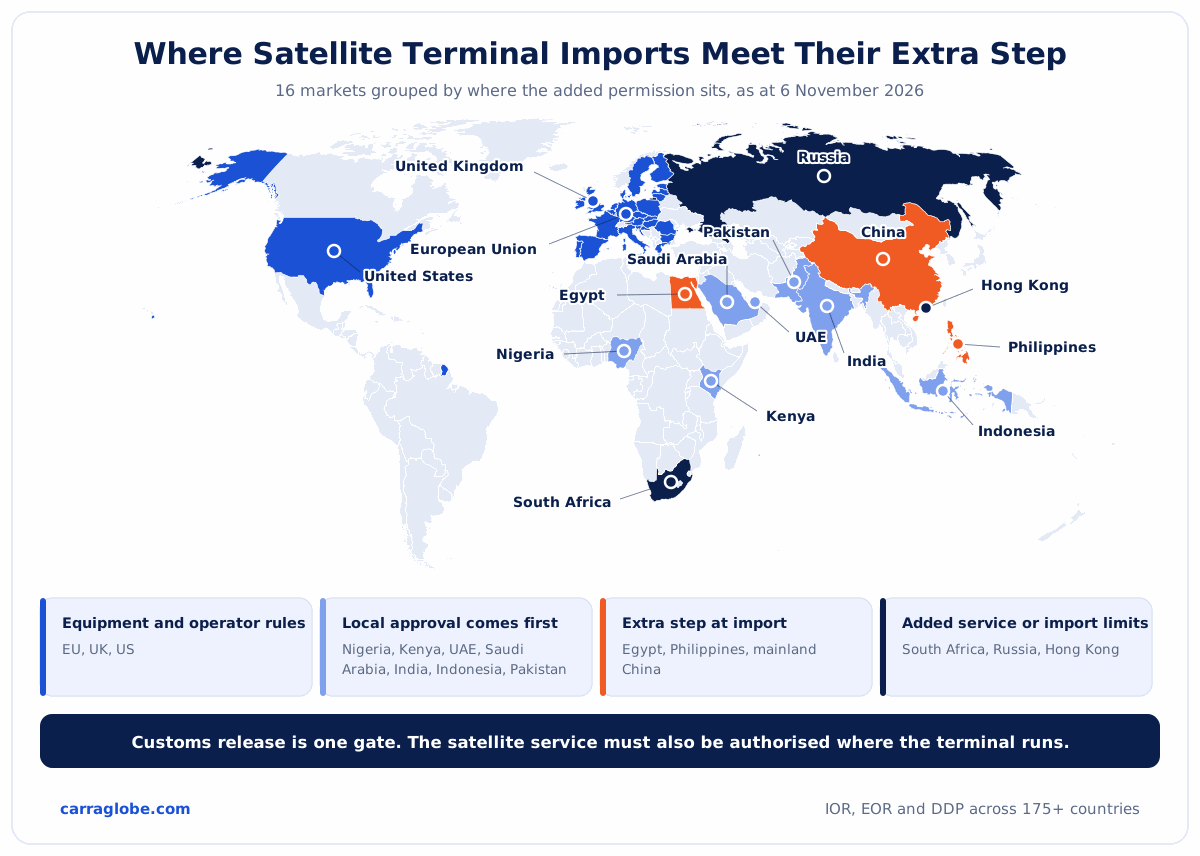
Country rules at a glance
| Market | Equipment approval | Import clearance | Operator, spectrum and service authorisation |
|---|---|---|---|
| European Union | CE marking under the Radio Equipment Directive | No satellite-specific permit, normal customs apply | ECC Decision (17)04 recommends licence exemption for some fixed earth stations, subject to conditions and national rules |
| United Kingdom | UK radio equipment rules | No satellite-specific permit, normal customs apply | May be covered by the operator’s NGSO network licence in its bands |
| United States | FCC equipment authorisation rules | Must meet FCC import conditions | Operator’s FCC authorisations must cover the service |
| Nigeria | NCC type approval per model | Approval needed before import | Landing rights for foreign operators, local operators need operational and frequency licences |
| Kenya | CA type approval | CA clearance via the single window where required | Licensed framework |
| South Africa | ICASA type approval, local entity | No separate permit confirmed | Service, network and spectrum licences, network licensing framework under review |
| Egypt | NTRA type approval | Separate NTRA import permit | Operator framework does not cover non-GSO, confirm route with NTRA |
| UAE | TDRA registration and type approval, foreign firms can register | TDRA customs clearance permission | Providers need TDRA authorisation, a LEO licence was granted in August 2026 |
| Saudi Arabia | CST device approval | CST customs clearance permission | Separate CST authorisations for NTN networks and services |
| India | MTCTE certification | Possession authorisation may apply to imports for sale | Check the provider’s authorisation under the 2023 Act framework |
| Indonesia | Komdigi certification | No separate permit confirmed | Certified satellite modems tied to Indonesian operators |
| Pakistan | PTA type approval | Compliance certificate for type-approved terminal imports | Licence framework, issuance unconfirmed |
| Philippines | NTC type acceptance | NTC permit to import, seven-day DTIP route not yet confirmed in force | Registered DTIPs may access satellites, subject to spectrum rules and filing access terms |
| Mainland China | Licences and radio approvals | Must be declared to customs | Only systems lawfully operating in China |
| Russia | Frequency decision required | Specified equipment banned without a frequency decision from 1 November 2026 | Separate service and frequency authorisations required |
| Hong Kong | Type approval and a pre-use application on the fixed broadband route | Import permit for radio transmitting apparatus, unless a dealer licence or exemption applies | Carrier licence for fixed broadband, registered class licence for mobile satellite services |
These are selected markets, and the table does not confirm that any operator or model is authorised in each. The sections below give the detail and the official source.
What changed in 2026
- February. OFCA set out Hong Kong’s satellite broadband licensing routes.
- 1 May. The UAE’s Type Approval Policy Version 4 took effect.
- June. ICASA’s Notice 3992 set out the licences constellation services can need in South Africa.
- 25 June. India moved new telecom service authorisations to a DoT portal under the Telecommunications Act, 2023.
- 6 August. India’s portal began taking radio equipment possession applications, including for imports for sale.
- 28 August. The TDRA granted a 10-year licence to a non-geostationary operator.
- 6 October. Hong Kong proposed licensing satellite operators per constellation rather than per satellite.
- 1 November. Russia’s six-month import ban on specified satellite equipment began.
- 2 November. ICASA opened phase II of its network licensing inquiry.
- Coming next. The EU’s radio cybersecurity rules end on 11 December 2027 under Delegated Regulation 2026/339, when the Cyber Resilience Act applies in full.
Equipment and operator permissions in the EU, UK and US
European Union. Terminals are generally radio equipment under the Radio Equipment Directive, so they need a conformity assessment and CE marking, and the importer must check these before sale. The cybersecurity requirements in Delegated Regulation 2022/30, applied from 1 August 2025 by Delegated Regulation 2023/2444, cover the radio equipment categories in scope, so check which apply to the model. Delegated Regulation 2026/339 repeals 2022/30 from 11 December 2027, when the Cyber Resilience Act applies in full.
ECC Decision (17)04 provides for licence exemption of certain fixed earth stations under set technical conditions, but its effect depends on national rules. Our guide to CE marking obligations for importers covers the importer’s duties.
United Kingdom. For non-geostationary terminals, Ofcom’s earth station network licence can authorise an unlimited number of user terminals on the licensed system in its bands, so end users generally need no individual licence when covered by it. Other rules can apply to geostationary, maritime and airborne earth stations. The equipment must meet the UK radio equipment rules, which recognise CE marking in Great Britain indefinitely. See our page on importer of record in the UK.
United States. Three separate rules apply. A device cannot be marketed before FCC equipment authorisation unless an FCC exception applies, each import must meet one of the FCC import conditions, and the operator needs its own FCC authorisations for its satellites and earth stations. Check that all three cover the deployment.
Where a local approval comes first
Nigeria. The NCC’s satellite guidelines and type approval FAQ require approval of the model before import for sale or deployment, and a SONCAP certificate does not replace it. Under the NCC’s space services rules, a foreign operator’s landing permit only lets it land signals in Nigeria, and service to customers must come through locally licensed operators holding the relevant operational and network frequency licences. Our guide to importer of record in Nigeria covers the import side.
Kenya. The Communications Authority’s equipment regulations require type approval before use, which can rest on a foreign approval, and the authority has 60 days to decide the application, which is not a customs timeline. Under Regulation 17, commercial suppliers, importers and distributors need a CA licence, while individuals may import type-approved terminals solely for personal use. Regulation 16 lets the authority exempt equipment imported temporarily for re-export. Where CA clearance is needed, it goes through the Kentrade single window, as our guide to the Kenya CED licence explains.
UAE. The TDRA’s Type Approval Policy Version 4 has applied since 1 May 2026. Its official FAQs say companies established outside the UAE can register with a trade licence from their home country, with manufacturer or supplier registration as the first step, while commercial customs clearance is a separate permit for registered entities that meet its conditions. The TDRA granted a 10-year licence to a non-geostationary operator on 28 August 2026, but that does not remove the equipment and customs steps. See our page on importer of record in the UAE.
Saudi Arabia. The CST runs device approval and customs clearance permission through its equipment licensing system. Its technical specification RI028 for satellite interactive and user terminals references standards written for geostationary systems, so confirm how a non-geostationary model is assessed. Satellite service providers are licensed separately under the non-terrestrial network regulations. Our guide to Saudi ICT certificates covers the wider picture.
India. India’s notification S.O. 982(E) of 25 February 2025 added NGSO user terminals to mandatory testing and certification, applying once 180 days had expired, so from late August 2025. From then, listed equipment may not be imported, sold or used without certification.
Certification does not authorise the service or frequencies. The DoT’s satellite service authorisation list is dated 10 June 2025, and new authorisations have run through a new DoT portal under the Telecommunications Act, 2023 since 25 June 2026. Since 6 August 2026, the portal has also taken applications under the Telecommunications (Radio Equipment Possession Authorisation) Rules, 2026, which cover possessing radio equipment for sale, including importing it for sale. See our page on importer of record in India.
Indonesia and Pakistan. Indonesia’s Permenkominfo 3/2024 requires certification for imported equipment. For satellite phones and modems, the applicant needs an agreement with an Indonesian satellite service operator and must not sell outside that channel. Article 20 is an exemption from the certificate requirement only, not from customs. It covers up to two customer-premises equipment (CPE) units brought in as baggage or by post for the owner’s non-commercial use. Separate routes for research, disaster response, trials and government use carry their own conditions, including a one-year limit. See our page on importer of record in Indonesia.
In Pakistan, the PTA lists satellite terminal equipment as needing type approval, and its guidance requires a PTA Certificate of Compliance (CoC) for customs clearance of type-approved terminal imports.
Where import clearance has extra steps
Egypt. Article 44 of Egypt’s telecom law bars importing telecom equipment without an NTRA licence, and the NTRA lists satellite communication equipment as needing type approval, issued about 14 days after the fee is paid. Its own guidance says the certificate is not an import permit, and equipment named in a defence ministry resolution also needs security consent under Article 44 of the Telecommunication Regulation Law.
The NTRA’s satellite operator framework for foreign satellite operators does not cover non-geostationary systems. That limits the route rather than banning every terminal. Article 45’s personal-use exemption does not cover other radio equipment unless the NTRA specifies it, and Article 46 bans importing used terminal equipment for trading. See our page on importer of record in Egypt.
Philippines. Commercial imports of radio equipment, including satellite transceivers, need an NTC permit to import, which can require a dealer permit and type acceptance documents. The Konektadong Pinoy Act rules say the spectrum management framework must give Data Transmission Industry Participants (DTIPs) a seven-day deemed approval on import applications for type-approved equipment that meets international standards. Do not rely on it until that framework and the NTC’s procedures are in force.
Registered DTIPs may also access satellite systems directly, subject to spectrum rules and filing their access terms. Neither change is a general exemption, and neither removes type acceptance or import permits. Our guide to importing IT equipment into the Philippines without a local entity covers the importer side.
Mainland China. The provisions on direct-to-satellite terminal services, in force since 1 June 2025, regulate the supply and use of terminals that connect directly to satellites. Conventional VSAT and earth station set-ups can also fall under other telecom and radio rules. Article 18 requires the relevant telecom and radio approvals and allows connection only to satellite systems lawfully operating in China.
Article 19 requires importers, travellers and recipients of mailed terminals to declare them to customs and accept inspection. The service side is stricter. Under Article 28, providers of direct-to-satellite terminal services to users in China must use ground facilities in China, connect to a lawfully operating domestic network and process domestic user data there. Article 29 routes international traffic through an approved gateway and requires State Council telecom approval to use a foreign organisation’s satellite resources. Our page on importer of record in China covers the wider rules.
Markets with added service and import restrictions
South Africa. ICASA’s type approval regulations let only South African registered entities apply. Its June 2026 Notice 3992 clarifies that constellation services can need individual service, network and spectrum licences. Separately, ICASA announced on 2 November 2026 a phase II discussion document in its inquiry into the individual network licensing framework. It looks at the transfer framework and demand for more licences, and invites comments rather than applications. An existing licence can be transferred only with ICASA’s prior written permission under section 13 of the Electronic Communications Act, on an application by the licensee. See our page on importer of record in South Africa.
Russia. Government Decree 1444 of 31 October 2026, as reproduced in Russian legal databases, bans for six months from 1 November 2026 imports of specified radio equipment that works with foreign satellite systems and lacks a frequency decision from the State Commission for Radio Frequencies. Its annex lists codes 8517 61 000 2, 8517 61 000 8, 8517 62 000 9 and 8517 69 900 0. A code match alone does not settle it, since the product description and function also count, so check the exact model before accepting an order.
Hong Kong. OFCA’s February 2026 paper, an advisory committee paper rather than a new rule, describes the current set-up. For fixed satellite broadband under the Unified Carrier Licence, user terminals are network equipment operated by the licence holder, with type approval and a separate application before use. Mobile satellite services work differently. They use licence-exempt spectrum and registered local SIM cards, under a class licence held automatically by qualifying providers, who must still register.
Separately, section 9 of the Telecommunications Ordinance requires a Communications Authority permit to import radio transmitting apparatus, unless the importer holds a licence to deal in it or an exemption applies. On 6 October 2026 the Government told LegCo its initial direction is to move from one pair of operator licences per satellite to one per constellation, with findings targeted for announcement by the end of 2026. See our guide to importer of record in Hong Kong.
The tariff code for satellite terminals
A UK advance tariff ruling placed an L-band radio unit that works over commercial satellite systems in commodity code 8517 62. It is not a typical LEO broadband terminal, so treat it as an example rather than a precedent. A complete kit may be classified as a set or composite good, while items presented separately may each classify differently. Russia’s ban uses its own codes and descriptions, so a UK code does not settle it. Describe the terminal, antenna, router, power supply and accessories accurately on the invoice and packing list, as our guide to the HS code for routers and switches explains.
Why satellite terminals get held at customs
The rules above point to the same handful of failures, whatever the country.
- No approval for the exact model. Check that the certificate names the model and any variants being imported.
- The wrong importer. The named importer, applicant or distributor may not meet local registration or licensing rules, as in South Africa’s type approval or Kenya’s importer licence.
- A missing import permit or clearance. Egypt requires a separate NTRA import licence, the Philippines an NTC permit to import and Russia a frequency decision for specified equipment.
- A vague description. A description that does not match the product’s actual function invites questions, as our guide to fixing a wrong HS code on an invoice explains.
- Personal-use exemptions used for business. Exemptions are narrow and conditional. Indonesia’s personal-use route covers two units, and its research, disaster and trial routes have their own conditions.
- An encryption query. Some markets add an encryption check, as our guide to encryption import restrictions on network equipment explains.
One problem is not a customs hold at all. A terminal can clear customs and still be unlawful to activate if the operator’s licence does not cover its band, terminal type or maritime or airborne use.
Five checks before terminals ship
- Confirm the operator, service, bands and use are authorised in the destination, including fixed, mobile, maritime or airborne operation.
- Check the approval covers the exact model and hardware version, including the router.
- Name a local importer who can hold the approval and any permit where the rules require it.
- Apply for any import permit before booking, since permits can be tied to a single invoice.
- Describe the goods precisely on the invoice, with the model, function and tariff code.
How Carra Globe handles satellite terminal imports
The permissions are checked before the terminals move. Carra Globe acts as importer of record for telecom and IT equipment, which can include satellite terminals, routers and the power kit that ships with them. An IOR appointment does not replace equipment approval, importer registration, spectrum rights or a service licence, so we assess each destination separately, prepare the declaration and coordinate freight forwarding to site.
Carra Globe works through importer-side registrations and local importing structures appropriate to the goods and destinations it accepts, its own in some markets and established local structures in others. Approvals falling outside the available structure are flagged before a delivery date is agreed.
Our IOR by country page covers 175+ countries. For a quote, send the draft commercial invoice, the terminal make, model and hardware revision, the datasheet, quantity, the destination and site address, the satellite operator, service and frequency bands, whether the terminal is fixed, portable, vehicle, maritime or airborne, and whether the terminals are for resale or your own project. Reach us at info@carraglobe.com.
Satellite Terminals · Type Approval · Import Permits
Send the terminal model, destination and site. We will tell you which approvals, permits and importer the country requires before anything ships.
A satellite terminal can need equipment approval, an import permit and an authorised service before it is usable. So the useful conversation is which of those your destination asks for, who can stand as importer and how the goods are described. Where something sits outside the structure available, you hear that before a delivery date is agreed.
- Importer of record in the USA
- Importer of record in Saudi Arabia
- Importer of record in the Philippines
- Importing IT equipment into India without an entity
- Importing into Saudi Arabia without an entity
- Costs of IT hardware imports into Nigeria
- Faster IT imports in Kenya
- South Africa IOR rules for tech imports
- IT hardware into Egypt's free zones
- India's trusted source rules for telecom
- Indonesia TKDN local content rules
- Kuwait telecom import rules
- Hong Kong as an IT equipment hub
- White glove delivery in the UAE
- What an EORI number is
Free tools HS Code Finder Volumetric Weight Calculator Pallet Calculator
Shipping satellite terminals to a remote site? Send the draft invoice with models, quantities and values, datasheets, the destination and site address, the intended use and the satellite service you plan to use. We will come back on approvals, permits, the importer and timing.
Check my satellite terminal importFrequently asked questions
Do I need a licence to import a satellite internet terminal?
Usually you need equipment approval, and some countries also require an import permit or a locally registered importer. Rules differ widely, so check the destination before shipping.
Can I import satellite internet terminals for business use?
In many countries, yes, if the model is approved, the importer qualifies and the satellite service is authorised there. Personal-use exemptions do not cover commercial quantities.
What HS code is a satellite internet terminal?
There is no single code for every kit. A unit receiving, converting and transmitting data may fall in 8517 62, but antennas, routers or power supplies may differ. Check the destination’s tariff.
Which countries ban satellite internet terminals?
Russia prohibits imports of specified equipment for foreign satellite systems without a frequency decision. China restricts direct-to-satellite services using foreign resources. Egypt’s operator framework excludes non-geostationary systems, which is not a blanket ban.
Who can import satellite terminals into the UAE?
Companies registered with the TDRA, including foreign firms registering with a home-country trade licence. Commercial customs clearance needs a separate TDRA permit.
Why are satellite terminals held at customs?
Usually because the model lacks approval, the importer is ineligible, or an import permit, clearance letter or frequency decision is missing. A service licensing gap may instead block activation after release.
Is CE marking enough to use a satellite terminal in the EU?
No. CE marking covers the equipment, but the satellite service still needs authorisation. ECC Decision (17)04 recommends licence exemption only for some fixed earth stations, depending on national rules.
Does each satellite terminal need its own licence in the UK?
Often not. Ofcom’s non-geostationary earth station network licence can cover unlimited user terminals on the licensed system in its bands. Geostationary, maritime and airborne terminals can follow other rules.
Can a foreign company get type approval in South Africa?
No. ICASA accepts type approval applications only from South African registered entities, so a foreign maker or seller needs a locally registered applicant.
Do satellite terminals need certification in India?
Yes. Since late August 2025, NGSO user terminals need MTCTE certification before they are imported, sold or used. Certification does not authorise the satellite service or its frequencies.
Is Russia’s ban on satellite terminals permanent?
No. Decree 1444 runs for six months from 1 November 2026 and covers specified equipment for foreign satellite systems without a frequency decision. Check the exact model before accepting an order.
Does an importer of record replace a satellite operator’s licence?
No. An importer of record handles the import obligations and customs declaration. Equipment approval, spectrum rights and the operator’s service licence must still be in place for the destination.
Adjacent ground: the EU Cyber Resilience Act for hardware importers and SONCAP certification in Nigeria.
Sources and verification
Country positions were checked against regulator and government publications available on 5 and 6 November 2026.
- Classification. HMRC advance tariff ruling 600014371 on an L-band main radio unit in 8517 62 00 00.
- EU, UK and US. Delegated Regulation 2026/339, Delegated Regulation 2022/30 and 2023/2444, ECC Decision (17)04, the Radio Equipment Regulations 2017 guidance for Great Britain, Ofcom’s non-geostationary licensing page, 47 CFR 2.803 and 47 CFR 2.1204.
- Africa. NCC satellite guidelines, type approval FAQ and space services rules, CA equipment regulations (Regulations 3, 5, 16 and 17), ICASA type approval regulations and Notice 3992 (also on ICASA’s site), ICASA’s I-ECNS inquiry announcement of 2 November 2026 and licence transfer page, and NTRA type approval guidance, Law 10 of 2003 (Articles 44 to 46) and the satellite operator framework.
- Middle East. TDRA type approval FAQs, CST’s equipment licensing service, RI028 technical specification and non-terrestrial network regulations.
- Asia. DoT S.O. 982(E), GMPCS authorisations, the authorisation portal notice of 25 June 2026, Permenkominfo 3/2024 (Articles 12, 19 and 20), PTA type approval guidance, the NTC import licensing notification and the implementing rules of Republic Act 12234 (DICT copy), China’s direct-to-satellite provisions (Articles 18, 19, 28 and 29), OFCA TRAAC Paper 3/2026, section 9 of Hong Kong’s Telecommunications Ordinance and the Government’s LegCo paper of 6 October 2026.
- Russia. Government Decree 1444 of 31 October 2026 and its annex, following the earlier measure under Decree 488 of 29 April 2026. The official publication portal could not be accessed when this guide was checked, so the details are taken from the decree as reproduced in Russian legal databases.
- UAE licence. The TDRA’s announcement of 28 August 2026 granting a 10-year licence to a non-geostationary operator.
Disclaimer: This guide is for informational purposes only and does not constitute legal, customs or telecoms licensing advice. Requirements depend on the specific equipment, its classification, the satellite service and the importer. The position described is as at 6 November 2026. Confirm the current position with the relevant regulator or your importer of record before shipping.