
Three rules introduced in 2026 changed who may bring a 5G radio into a country, and none of them changed the radio. The UAE now asks whether the importer holds the approval or is authorised by the company that does. Kenya now asks whether the importer holds a distributor licence. The US now asks where a consumer router was produced. When shipping 5G equipment, a type approval certificate answers only one of the questions customs will put to a consignment of radio units, small cells or 5G routers.
The short version. Before 5G or radio equipment ships, confirm five things in the destination. The exact model holds the local approval, the importer is allowed to use that approval, any shipment permit is in place, the band and the licence fit the deployment, and no security or device rule blocks the model. A gap in any one of them can hold a shipment that is otherwise compliant.
Carra Globe provides importer of record, delivered duty paid and freight forwarding services, so we have a commercial interest in your answer. What follows is written to be usable whether or not you ever speak to us.
Five questions customs will ask when shipping 5G equipment
Regulators publish what an importer must hold, and customs checks it at the border. Rules differ by market, but the questions repeat. Work through them in this order, because each answer depends on the one before.
1. Is this exact model approved here?
Approval attaches to a model and its radio configuration, not to a product family. Canada’s radio standard RSS-Gen, issue 6 of July 2026 as amended in September, bars importing certified-category apparatus unless the model is on the Radio Equipment List, though an approved deferred listing allows import before sale. Nigeria’s regulator states plainly that importing non-type-approved communications devices is prohibited, and a SONCAP certificate does not stand in for it. A certificate for a sibling model with different bands does not cover the unit in the crate.
2. Is the importer allowed to use that approval?
This question is easy to miss, because the approval holder, the seller and the importer are often three different companies. Under the UAE’s type approval regime, version 4 of January 2026, commercial imports need an importer registered with the regulator that either holds the certificate or is officially authorised by its holder. The delegation is recorded in the regulator’s systems, so an informal letter is unlikely to be enough. Separate permits cover temporary imports for exhibitions or trials and equipment for an organisation’s own use.
Kenya went further in July 2026. Its Communications Authority now requires a Communications Equipment Distributor licence for businesses importing communications equipment for sale or wholesale distribution, and that licence is what lets the importer have equipment type approved and cleared. Imports for an organisation’s own use or on a temporary basis need checking separately. In India, the equipment type approval for licence-exempt wireless bands is applied for by the importer or an authorised Indian representative, while licensed-band 5G kit follows the telecom certification and spectrum routes.
3. Does the shipment need its own permit?
Some markets approve the model once and then check every consignment. The UAE issues a customs release permit for telecommunications devices per shipment, and each one is assessed individually. Saudi Arabia’s regulator sets its own import and clearance conditions for telecom and IT equipment. Malaysia pairs product certification with an import permit, as our guide to SIRIM compliance for IT hardware explains. An approved router can still wait at the airport if nobody applied for the release.
4. Do the band and the licence fit the deployment?
Equipment approval covers the product. A spectrum licence covers who may transmit, where and on which band. Saudi Arabia’s import licensing guide, published in the official gazette on 2 October 2026, ties telecom equipment imports to the owner holding the relevant service licence and, for wireless kit needing a frequency licence, to operating within the band assigned to that owner. The regulator decides within seven working days.
Bands also date a certificate. In October 2026, Indonesia issued a circular so that mobile phones already on the market without the newly auctioned 700 MHz and 2.6 GHz bands could have their certificates adjusted, with applications open until 15 April 2027. The circular covers handsets only, but it shows how a valid approval can still fall short of the bands a network now uses.
5. Does a security or device rule block the model?
In the US, the communications regulator added foreign-produced consumer-grade routers to its Covered List on 23 March 2026. New models in that category cannot receive equipment authorisation unless the producer obtains a conditional approval, although models authorised before the listing can still be imported and sold. Conditional approvals granted since April 2026 cover specific router series for a limited period, so the exact model matters.
From 16 July 2026, covered equipment listed in 2024 or earlier can no longer be imported under an old authorisation, subject to use-based limits and listed exceptions. A rule in force from October 2026 bars new authorisations for devices containing certain logic-bearing components made by listed entities. Our guide to importing network equipment into the US covers the wider process.
Nigeria added a device-level check on 7 October 2026. SIM-enabled devices brought in by an importer must now be verified, not just approved as a model, and the importer needs the regulator’s Sales and Installation licence. Encryption is usually an export classification question at origin rather than a customs import ban, though some markets do restrict it, as our guide to encryption rules for network equipment sets out.
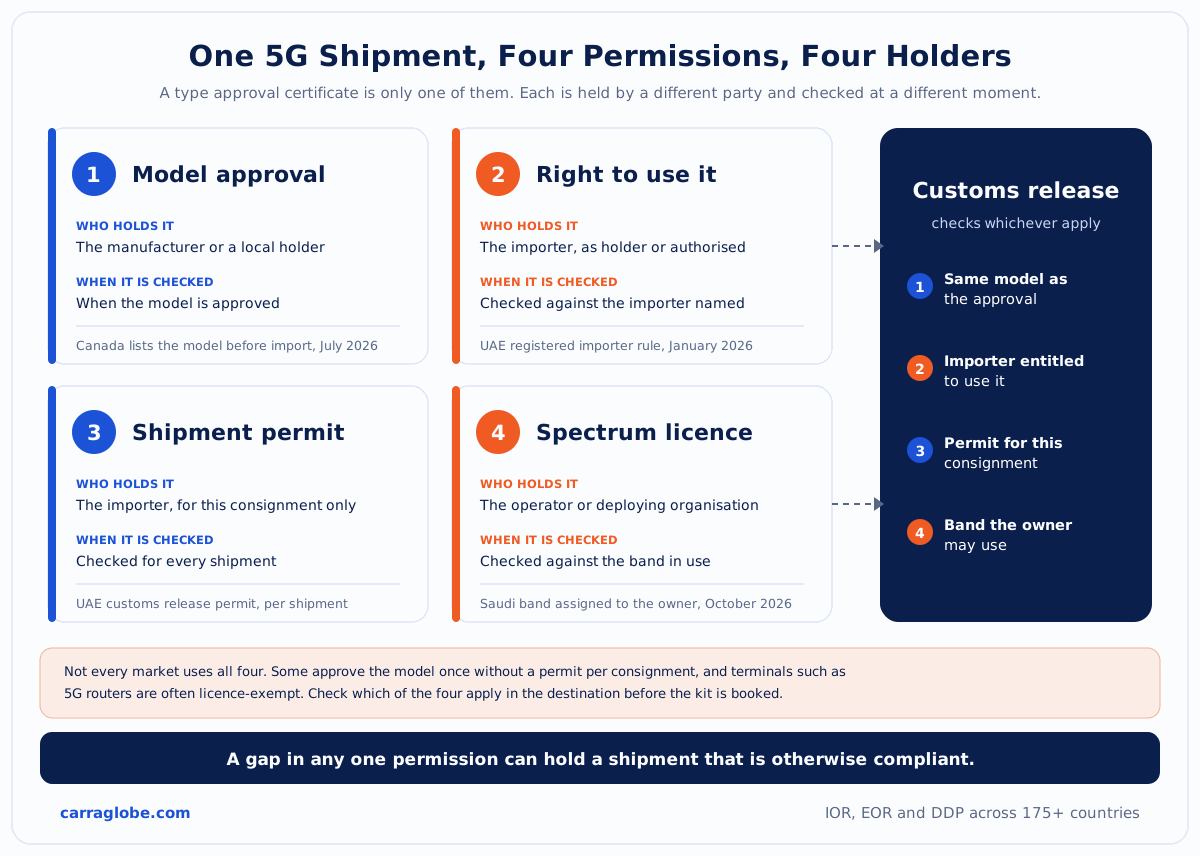
Base station, small cell, router or antenna
The kit type changes which questions bite hardest. Our importer of record for telecom equipment page covers the wider category, and the table shows the pattern for 5G.
| Kit | What it usually needs | What to watch |
|---|---|---|
| Radio units and base stations | Type approval in the destination, plus the operator’s spectrum licence | India eased some 5G base station test reports in February 2026, with a further notice in July |
| Small cells and private 5G | Type approval, and band rights for the organisation deploying it | A factory network does not inherit a mobile operator’s licence |
| 5G routers, CPE and modems | Type approval, and in the EU the radio cybersecurity rules in force since 1 August 2025 | The US router listing and device-level checks such as Nigeria’s |
| Antennas and RF parts | Often outside transmitter rules when passive, depending on the market | Active antennas and amplifiers are radio equipment and are assessed as such |
Terminal and network kit can also differ on licensing. The UK extended its licence exemption for mobile terminals to 5G across all mobile bands from 24 March 2026, which covers handsets and similar terminals but not the base stations they connect to.
Purpose changes the route as much as the hardware does. The same small cell can be sold to a distributor, installed for a company’s own private network or sent for laboratory trials, and each can need a different importer, permit or licence. Tell your forwarder which one applies before anything is filed.
What each market expects before the kit lands
Each row sets out the approval, who can import against it and what changed recently. Lead times for each approval vary widely, as our guide to certification lead times by country shows.
| Market | Approval and regulator | Who can import against it | What changed in 2025 and 2026 |
|---|---|---|---|
| UAE | Type approval from the telecoms regulator, TDRA | A registered importer holding the approval or authorised by its holder | Version 4 of the regime, January 2026, with a release permit per shipment |
| Saudi Arabia | Conformity certificates through SASO, with CST licences where needed | An owner holding any required service and frequency licence | SASO 3114 certificates from 1 November 2026, and the October 2026 import guide |
| India | MTCTE for notified categories, plus wireless approval (ETA) for licence-exempt radio kit | The importer or an authorised Indian representative for ETA | Base station test report relief in February 2026, revisited in July |
| United States | Equipment authorisation from the FCC | Depends on the Covered List, not only the grant | Router listing in March 2026, import ban in July, component rule in October |
| Canada | Certification and listing by ISED | Import once the model is listed, or under an approved deferred listing | RSS-Gen issue 6, July 2026, amended September 2026 |
| Mexico | Homologation, now administered by the new regulator, CRT | Check the holder on the CRT register before shipping | New telecoms law in force from 17 July 2025 |
| UK | CE or UKCA in Great Britain, EU rules in Northern Ireland | Any importer meeting the importer duties | 5G terminal licence exemption from 24 March 2026 |
| EU | CE conformity under the Radio Equipment Directive | Any importer meeting the importer duties | Cybersecurity rules since 1 August 2025, with their delegated act repealed on 11 December 2027 as the Cyber Resilience Act takes effect |
| Kenya | Type approval from the Communications Authority | For commercial imports, a holder of the Communications Equipment Distributor licence | Licence required from July 2026 |
| Nigeria | NCC type approval | Licensees, makers or vendors apply, and commercial importers need a Sales and Installation licence | Device verification from 7 October 2026 |
| South Africa | ICASA type approval | The approval or exemption must cover the model | Enforcement against non-approved devices in October 2025 |
| Japan | Technical conformity certification under the Radio Act | Certified equipment carries the conformity mark | Later inspection notice for some pre-arrival declarations from July 2026 |
| South Korea | Conformity assessment through the radio agency, RRA | Certified models, with set exemptions for testing and R&D | No major change found |
| Indonesia | Certification from the digital ministry | Check the certificate and its holder before shipping | Handset certificate adjustment for new bands from October 2026 |
| Malaysia | Certification through SIRIM under the communications regulator’s rules | An import permit per shipment, covering one model each | Product certification and the import permit run as separate steps |
For the detail behind individual rows, see our guides to SASO 3114 certificates in Saudi Arabia, the trusted source rule for Indian telecom and NOM certification in Mexico.
When the model has no approval yet
Some approval gaps can be closed, though rarely in the days before a deployment, and others rule out import altogether. Shipping and hoping is the costly route, because unapproved kit can be refused release, sent back or seized. The realistic options depend on the market and the purpose.
- Apply for local approval first. A local holder or partner applies, often using test reports from a recognised foreign laboratory.
- Use a defined exemption. South Korea lets importers apply through its customs portal to bring in up to 10 units for testing or up to 1,500 for research and development, with set conditions.
- Import temporarily, where the regulator allows it. A carnet or temporary import bond settles duty and tax, not telecom approval, so confirm the destination’s temporary approval or exemption first.
Seizures are real, although most reach the public as regulator warnings rather than case reports. In October 2025, South African police and the communications regulator confiscated more than a thousand non-type-approved devices, together with two-way radios and approval labels, at premises in Johannesburg. That action came after import, which is a reminder that clearing customs does not end the exposure.
If the shipment is already booked
- Hold the cargo at origin until the model’s status is confirmed on the destination register, using the official sources listed below.
- Confirm that the named importer holds the approval, or a recorded authorisation from its holder where the market requires one.
- Apply for any shipment permit before the kit lands, not after it reaches the terminal.
- If the kit has already landed without approval, the realistic options are applying for it, changing to an importer entitled to use an existing approval where the law allows, or re-export.
How Carra Globe handles 5G and radio shipments
Carra Globe and its team ship radio units and base station equipment, small cells and indoor 5G, antennas and RF parts, and 5G routers, CPE and modems, among other radio devices. We act as importer of record at destination and as exporter of record where the origin requires it.
Who holds the approval varies by shipment and by country. Sometimes it is the manufacturer or the client, and sometimes our local partner. Where a model has no approval in the destination, our local partner can apply for it before the shipment moves, so the kit leaves once the paperwork that customs will ask for is in place.
Carra Globe works through importer-side registrations and local importing structures appropriate to the goods and destinations it accepts, its own in some markets and established local structures in others. Approvals falling outside the available structure are flagged before a delivery date is agreed.
For a quote, send the following, and our trade compliance team reviews the approval position first. Reach us at info@carraglobe.com.
- The exact model numbers and hardware revisions, with datasheets showing frequency bands
- Any existing approval references and the name of their holder
- The proposed importer and the purpose, whether sale, own use or trial
- The draft commercial invoice and packing list, with weights and dimensions
- The operator or spectrum authority, where the deployment needs one
- The collection and delivery addresses
5G · Radio Equipment · Type Approval · Customs
Send the models and the destination. We will tell you which approvals, permits and licences the shipment needs before it is booked.
A 5G radio can hold a valid certificate and still wait at the border because the importer cannot use it, the shipment has no permit or the band does not fit. So the useful conversation starts with the model numbers, the bands and who will import. Where something sits outside the structure available, you hear that before a delivery date is agreed.
- Importer of record for data centre equipment
- HS code for routers and switches
- Importing IT equipment into India without an entity
- Kuwait telecom import rules
- Importing network equipment into Ethiopia
- Indonesia's local content rules for IT hardware
- India's import authorisation for IT hardware
- The EU Cyber Resilience Act for importers
- CE marking obligations for importers
- EU dual-use export controls
- When an accredited lab report is rejected
- Importer of record in the UAE
- Importer of record in Saudi Arabia
- Importer of record in Japan
- Importer of record in South Korea
Free tools HS Code Finder Volumetric Weight Calculator
Shipping 5G or radio kit? Send the draft invoice, model numbers and datasheets with frequency bands, any existing approvals, weights and dimensions, and the collection and delivery addresses. We will come back on approvals, permits, customs and timing.
Check my 5G shipmentFrequently asked questions
Do I need type approval to ship 5G equipment abroad?
Usually yes, for radio or network kit sold or used in the destination. The route depends on the country and the product, and test or research units may qualify for limited exemptions.
Can the importer use the manufacturer’s type approval?
In some markets. The UAE allows import by the approval holder or an importer it has officially authorised. Elsewhere, check whose name the approval must carry before booking.
Is type approval the same as a spectrum licence?
No. Approval covers the product, while a spectrum licence covers who may transmit on which band. Saudi Arabia ties some telecom imports to both.
Can foreign-made 5G routers still be imported into the US?
Models authorised before March 2026 generally can, unless another restriction applies. New foreign-produced consumer-grade models need a conditional approval to get FCC authorisation.
What changed for UAE telecom imports in 2026?
The January 2026 type approval regime requires commercial imports through a registered importer that holds the approval or is authorised by its holder, with a release permit per shipment.
Does a passive antenna need type approval?
Often not in the same way as a transmitter, and it depends on the market. Active antennas with RF amplification generally need approval, subject to local rules.
Can I ship 5G test equipment without approval?
Sometimes. South Korea allows set quantities for testing and research through a customs application, and the UAE has a temporary permit for trials. Elsewhere, check first.
Does encryption stop a 5G shipment at customs?
Usually encryption is an export classification question at origin. A few markets restrict it on import, so classify the equipment before it ships.
Adjacent ground: importing satellite internet terminals and the qualified agent certificate in Cambodia.
Sources and verification
Each rule was checked against regulator, legislative or official publications available on 11 November 2026, using the newest version we could find.
- UAE. TDRA’s Type Approval Regime for Telecommunications Equipment, version 4, January 2026 and its equipment registration service.
- Saudi Arabia. The Import Licensing Guide in the official gazette, 2 October 2026, CST’s clearance and equipment approval services and SABER’s SASO 3114 transition notice.
- India. The Department of Telecommunications’ equipment type approval page, TEC’s MTCTE notices and its exemption letter of 18 February 2026.
- United States. FCC DA 26-278 of 23 March 2026, DA 26-635 of 26 June 2026, the Second Report and Order, November 2025 and the Third Report and Order, September 2026 and the FCC’s Covered List.
- Canada. ISED’s RSS-Gen, issue 6, July 2026, with its September 2026 amendment.
- Mexico. The telecommunications law in the official gazette, July 2025 and the CRT’s register of homologated equipment.
- UK and EU. Ofcom’s mobile terminal licence exemption update, March 2026, the UK government’s factsheet on Regulation (EU) 2022/30, Delegated Regulation (EU) 2022/30 and Delegated Regulation (EU) 2026/339.
- Africa. The Communications Authority of Kenya’s notice on importation and distribution, July 2026, the NCC’s type approval and device verification guide, its device checker and type approval FAQ and type approval FAQ, ICASA’s type approval guidelines and the South African Police Service’s statement of 23 October 2025.
- Asia. Japan’s Ministry of Internal Affairs and Communications on technical regulations conformity certification, Japan Customs’ notice of 1 May 2026, South Korea’s RRA on import exemptions, the US NIST Korea MRA annex, Indonesia’s certification notice of 26 October 2026 and SIRIM’s certification requirements for communications equipment.
Disclaimer: This guide is for informational purposes only and does not constitute legal, customs or regulatory advice. Requirements depend on the specific equipment, its radio configuration, the destination, the importer and the intended use. The position described is as at 11 November 2026. Confirm the current position with the relevant regulator, the approval holder and your importer of record before shipping.