
Two suppliers quote DDP into the same country, and you now have to compare DDP quotes that look like the same job. Same equipment, same destination, same week. One is meaningfully cheaper, and the obvious question is why.
The short version. Two DDP quotes differ because sellers make different, unstated assumptions about what the price covers, who acts as importer, what happens when goods are held, which risks stay with you, and where delivery ends. An Incoterm allocates cost and risk between buyer and seller, but the destination country decides who may be named as importer on the customs entry. Ask both bidders the same eleven questions in writing before you sign, and score the answers rather than the headline numbers. Where local rules require the buyer to clear imports, ICC guidance says DDP cannot be used and DAP is the appropriate rule.
Carra Globe provides importer of record, exporter of record, delivered duty paid and freight forwarding services, so we have a commercial interest in your answer. What follows is written to be usable whether or not you ever speak to us.
The dangerous assumption is that both quotes are offering the same thing. One may include import VAT while the other leaves it undefined. One may have a legally recognised importer behind it while the other relies on a forwarder. Sometimes the cheaper quote is genuinely better, and the price alone will not tell you which.
This is not an explanation of what DDP means. It is a working method to compare DDP quotes, built on eleven questions that surface the main structural risks and separate a price you can rely on from a number that only looks like one. Ask them before you sign, because once the goods are in the air your leverage is gone.
Why two DDP quotes can differ so much
Sellers make different assumptions about five things and rarely state any of them. Confirm too which edition of the rules your contract uses, since Incoterms 2020 and earlier editions differ.
- What is inside the price, particularly whether import tax, brokerage, port charges and final-mile delivery are included or added later.
- Who acts as the importer, and whether that party is legally able to, which goes to the heart of what an importer of record does.
- What happens when something goes wrong, including examination, storage and demurrage.
- Which risks the seller has quietly left with you, such as unloading, permits or product approvals.
- Where “delivered” actually ends. “DDP Germany” is not a complete delivery instruction. A quote to a named loading dock and one that also covers secure site access, moving kit inside and placing it on a data centre floor are not the same scope.
The single most useful thing to remember. An Incoterm allocates cost and risk between two commercial parties. It does not decide who the customs authority will accept as the importer. A contract can say DDP all it likes, but the destination country decides whose name may appear on the entry.
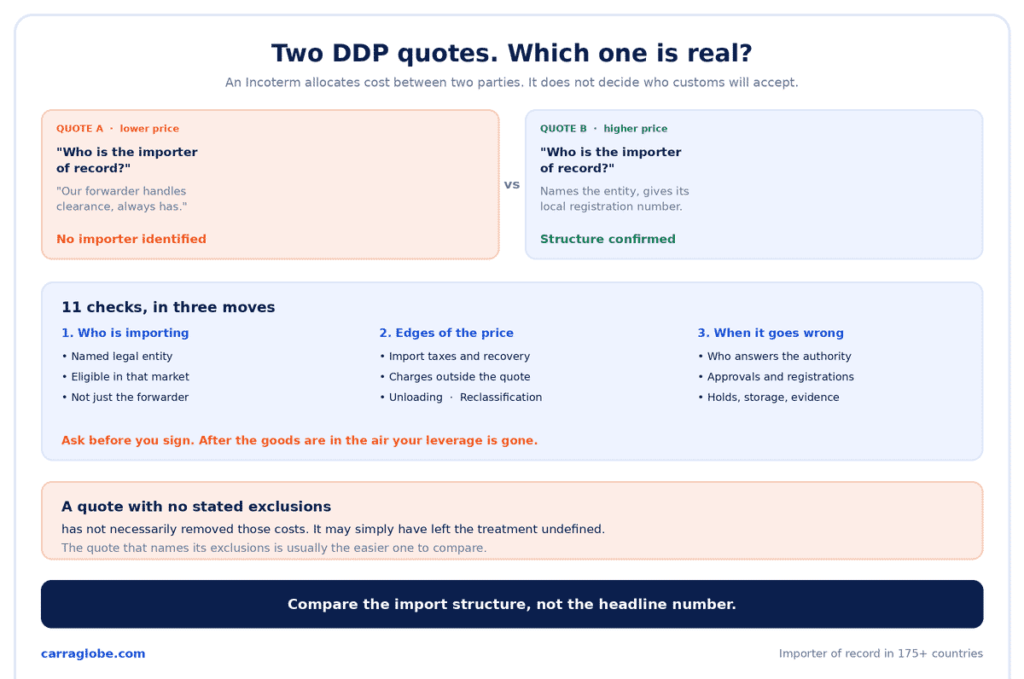
The 11 questions to compare DDP quotes
Send these to both bidders. The answers, and how quickly they come back, will tell you more than the numbers did.
First, establish who is actually importing.
- Which legal entity will be named as importer of record on the customs entry? Not “we handle clearance”, but a company name. If the answer is vague, that is the finding.
- Is that entity permitted to act as importer in this destination? Some markets restrict who may act as importer and may require local establishment, registration, tax credentials or other authorisation.
- Is your freight forwarder or broker being named as the importer? In many countries a logistics provider may act as a customs agent but not as the legal importer. Our note on freight forwarder versus importer of record explains why that distinction is not academic.
Second, find the edges of the price.
- Does the price include import taxes, and can anyone recover them? VAT, GST, sales tax and excise are different levies with different treatment. If the seller pays import VAT or GST it cannot reclaim, that cost is buried in your price permanently.
- Which charges sit outside the quote? Ask specifically about customs examination, storage, demurrage and detention, and whether they are passed through at cost or marked up.
- Who bears unloading? Under Incoterms 2020 DDP, the seller delivers on the arriving means of transport, ready for unloading, and is not obliged to unload. The buyer normally bears the unloading cost unless the seller has agreed to cover it under the contract of carriage or the sales contract. For racked equipment that is not a trivial line. List unloading, inside delivery and any white glove handling separately, because DDP alone does not promise any of them.
- What happens to the price if the classification changes? A different HS code can change the duty rate or bring other import requirements, even where the rate stays the same. Record the assumed code, agree who bears any extra cost, and agree how a dispute would be settled.
Third, test what happens when it goes wrong.
- Who holds the compliance risk if the entry is queried? The importer of record answers to the authority, so if that is not the seller, the exposure has moved somewhere. Set out each party’s responsibilities in the contract, including an indemnity for losses caused by the seller’s own errors or declarations. An indemnity moves cost between the parties, but it cannot change who the law holds liable.
- Are product approvals and producer-responsibility registrations inside the scope? Telecom and electrical safety approvals, certification, and registrations covering electrical waste, batteries and packaging all sit outside customs clearance. So do export-control classification and sanctions screening, which matter for servers and networking hardware. Each is frequently assumed to be the other party’s problem.
- What is the position if the shipment is held? Ask who pays storage, who talks to the authority, and at what point the cost comes back to you. Our guide to resolving a customs hold on IT shipments shows how quickly those costs build.
- Can they show this entity has previously imported comparable equipment into this country? Treat that as evidence of experience, not as proof that the proposed structure is valid for your shipment.
What the questions actually surface
Here is an illustration of how this plays out, without the numbers, because the numbers are never the interesting part. Two bidders quote DDP for networking equipment into a market that requires a locally established importer. Quote A is lower, and procurement is ready to sign.
Question one goes out to both. Bidder B names a company, gives its local registration number, and confirms it has entered comparable equipment there. Bidder A answers that its forwarder handles clearance and has done for years.
That is the whole comparison, and it happened before anyone looked at a number. Bidder A has not identified an importer, because a forwarder may act as a customs agent without being permitted to stand as the legal importer. A was pricing a shipment, while B was pricing a shipment plus an import structure. Nothing goes wrong at quoting, booking or in the air. It goes wrong at the border, when somebody has to be named on the entry and the answer turns out to be nobody.
Three things people assume DDP covers
Three more assumptions are worth testing, and they sit outside the eleven questions because they are not about the quote at all. They are about what buyers believe the term itself includes, and each has caught out companies moving high-value hardware.
- Insurance. DDP places the risk on the seller until delivery, but the rule does not require the seller to insure the goods. Confirm whether cargo insurance is included and what it covers, which matters more the higher the equipment value.
- Title. DDP does not decide when ownership passes, so confirm that separately, particularly if you are financing the equipment or using it as security.
- Currency and exchange rate. Ask what currency the price is in, what validity period applies, and whether duty and import tax are calculated at a fixed rate, the customs rate or the provider’s own. A lower headline number in a volatile currency can end up costing more.
Reading the answers
You are not looking for perfect answers. You are looking for whether the bidder has thought about the destination at all.
| What you hear | What it usually means |
|---|---|
| A named entity, with its registration in that country | They have done this before. Verify, then proceed |
| “Our forwarder handles it” | Nobody has established who is legally importing. Ask again |
| “Everything is included, do not worry” | No scope has been defined, so disputes will be resolved in their favour |
| “We always ship DDP, it is never a problem” | A record of past shipments is not evidence of a lawful structure |
| A DDP price barely above the freight cost | A reason to dig, not a verdict. Ask for the assumed customs value, classification, duty and tax workings and the exclusions list. A low price might reflect a genuine discount, missing costs or a wrong valuation assumption, and the headline alone proves none of them |
| A clear list of what sits outside the price | The best answer available, because you can now compare scope rather than headline numbers |
The quote that names its exclusions is often the more useful one. A quote with no stated exclusions has not necessarily removed those costs, and it may simply have left their treatment undefined.
The DDP quote scorecard
Run both bids through these eleven lines in writing before you sign. Tick each one for Quote A and Quote B. The bid with fewer gaps is usually the cheaper one in practice, whatever the headline says.
Confirm in writing for both quotes
☐ The legal entity named as importer on the customs entry
☐ That entity’s eligibility and registrations in the destination checked
☐ Forwarder, broker and importer roles kept distinct
☐ Customs value, classification, duty and import tax assumptions stated
☐ Import VAT or GST treatment, and who can recover it
☐ Brokerage, examination, storage, demurrage and detention costs defined
☐ Unloading, inside delivery and the exact delivery point agreed
☐ Who pays if the classification changes
☐ Product approvals, producer registrations and export-control checks scoped
☐ Customs holds, compliance responsibility and indemnities agreed
☐ Evidence of comparable imports into this destination
The delivery line catches more shipments than it should. Give the full address, including loading dock, floor and access restrictions, and say whether the price stops at the dock or carries the kit inside. That gap is where a surprising amount of cost hides.
DDP Quotes · IT Equipment · Importer Of Record
Send us both DDP quotes. We will tell you what each price leaves out.
Most DDP quotes that look alike differ on who is named as importer, what tax and storage sit outside the price, and where delivery really ends. So the useful conversation is which entity goes on the entry, whether it may act in that destination, what each quote excludes, and what the unloading and classification risks are. Where an approval sits outside the structure available, you hear that before a delivery date is agreed.
- IOR for VARs and technology resellers
- IOR for system integrators
- When the customer will not be IOR
- Who is liable when a reseller imports
- Paper IOR versus operational IOR
- How late you can appoint an IOR
- Importing IT kit without a local entity
- Your first shipment into a new country
- IOR for small shipments
- Importing kit when no sale takes place
- Multi-country IT equipment rollouts
- Indirect representation and import VAT
- Customs power of attorney explained
- ATA carnet, temporary import bond or IOR
- EU de minimis changes and DDP
Free tools HS Code Finder Volumetric Weight Calculator Pallet Calculator
Comparing DDP quotes for servers or network kit? Send both quotes, the destination, the delivery address and your date. We will come back on who each bidder is naming as importer, what sits outside each price, and where the timing risk sits.
Review my DDP quotesWhere DDP quotes fail: importer eligibility by country
Question two is the one that turns a pricing exercise into a feasibility one. In some destinations the answer is already no, whatever the quote says.
Rules differ sharply. The United States lets a nonresident corporation enter merchandise for consumption, but only on conditions. Under 19 CFR 141.18, it needs a resident agent in the state where the port of entry is located, authorised to accept service of process, plus a bond with a resident corporate surety.
That US position may tighten. Executive Order 14411 of 3 June 2026 directs the authorities to stop foreign importers of record filing informal entries and to tighten the bond and CTPAT conditions on their formal entries, with wider importer eligibility rules due within 180 days. Our guide to the customs enforcement executive order covers what it means for importers.
This is not a fringe concern, and the ICC says so itself. Its guidance notes that some import customs authorities impose restrictions requiring the local importer, meaning the buyer, to carry out import clearance, and that in such cases DDP cannot be used and DAP is the appropriate rule.
In many destinations a foreign seller cannot simply act as the importer without local establishment, registration, tax credentials or other authorisation, and the requirements differ market by market. That is why the first question when you compare DDP quotes is not the price but whether the proposed importer structure is permitted in that destination at all. Our country pages set out the position for markets including China, Mexico, Brazil, India and Saudi Arabia.
A DDP quote into those markets is only real if somebody local is standing behind it. Either the seller has an entity there, or it has appointed a third party who does. If neither is true, the quote describes something that cannot happen, and you will discover that at the border rather than at the negotiating table.
Check the destination before comparing prices. Our IOR by country index sets out the position market by market.
If the answer is that DDP will not work
This is not a dead end, and it is worth knowing before you go back to the bidders. The ICC’s own answer is that where local rules require the buyer to carry out import clearance, DAP is the appropriate rule instead.
That changes the question from which supplier gives the best DDP price to who your importer is and what you actually need the supplier to do. The seller delivers to the named place, and you appoint an importer of record who is entitled to act in that market. Our comparison of DDP and DAP covers the trade-offs.
Two practical advantages come with it. You see the duty and tax as they actually fall rather than buried inside a supplier’s margin, and the import tax position sits with a party that may be able to recover it, which our guide to import VAT and the importer of record explains. Ask both bidders to quote DAP alongside DDP, because the comparison is often more revealing than either number alone.
Comparing like with like
Once the answers are in, you can compare the quotes properly. Score both against the same eleven checks rather than comparing headline numbers.
| Check | Quote A | Quote B |
|---|---|---|
| Importer of record named as a legal entity | Yes / No | Yes / No |
| That entity eligible in the destination | Yes / No | Yes / No |
| Duty included | Yes / No | Yes / No |
| Import tax treatment stated, and recoverable by whom | Yes / No | Yes / No |
| Customs brokerage included | Yes / No | Yes / No |
| Examination charges defined | Yes / No | Yes / No |
| Storage and demurrage defined | Yes / No | Yes / No |
| Unloading responsibility agreed | Yes / No | Yes / No |
| Classification change responsibility agreed | Yes / No | Yes / No |
| Product approvals and registrations in or out | Yes / No | Yes / No |
| Delivery point given as an address | Yes / No | Yes / No |
Fill that in for both bidders and the cheaper quote frequently stops being cheaper. The cheapest quote is not necessarily the lowest-cost one. The better quote is the one with the least undefined exposure for the scope you actually need.
What you are buying under DDP is not freight. It is somebody else carrying the import, and the price should reflect whether they can actually carry it. That is the difference between a transport quote and an import structure.
If you want to sanity-check the underlying numbers yourself, start with landed cost. Our guide to calculating landed cost sets out the components a DDP price should be covering, and our guide to DDP versus using your own importer of record covers when a different structure suits you better.
How Carra Globe helps
We sit on both sides of this. We quote DDP, and we are also the party clients name when a supplier’s DDP arrangement will not stand up in the destination market.
- Acting as importer of record across 175+ countries, so a named entity sits on the declaration rather than an assumption, and as exporter of record where the export side needs a named party too.
- Quoting DDP clearance with the exclusions stated, including how examination, storage and classification changes are treated.
- Reviewing an existing quote against the eleven questions above, and telling you plainly where it is thin.
Carra Globe works through importer-side registrations and local importing structures appropriate to the goods and destinations it accepts, its own in some markets and established local structures in others. Approvals falling outside the available structure are flagged before a delivery date is agreed.
If a competing quote is genuinely better structured than ours, we would rather say so than win the work and manage a problem at the border. Our case study on a server import into India shows what the structure looks like when it is done properly. If you are still choosing a provider, our guide to choosing an importer of record covers what to look for.
Use the checklist above before choosing the cheaper quote. If you want the structure reviewed, send both quotes and the destination to info@carraglobe.com, and we will tell you what the numbers are not saying.
Frequently asked questions
Why is one DDP quote cheaper than another?
Usually because it covers less, leaving out import tax, examination and storage, unloading or product approvals. Occasionally the importer structure behind it will not work in that destination.
How do I compare two DDP quotes?
Compare the import structure, not the headline number. Establish who is named as importer, whether that entity is eligible in the destination, and what sits outside each quote, then score both against the same checks.
Does a DDP quote include import VAT?
It should, since DDP puts import duties and taxes on the seller, but some quotes exclude it. Ask explicitly, and ask who can recover it, because unrecoverable VAT stays in your price.
What should a DDP quote include?
International freight, import clearance, customs duty, applicable import taxes, agreed brokerage and handling, and delivery to the named place. Confirm separately how unloading, examination, storage and classification changes are treated.
Does DDP mean the seller is the importer of record?
Not automatically. DDP allocates cost and risk between buyer and seller, while the destination country decides which entity may be named on the entry. In some markets a foreign seller cannot be the importer.
Can my freight forwarder be the importer of record?
Often not. A logistics provider may act as a customs agent without being allowed to stand as the legal importer, so ask which named entity goes on the declaration.
Does a DDP price include unloading?
Usually not. DDP delivery happens at the named place, ready for unloading, and the buyer normally unloads unless the seller has agreed otherwise. Name a precise address, since a country is not a delivery point.
What happens to a DDP price if the HS code changes?
The duty changes and someone absorbs it. Agree in the contract whether reclassification is at the seller’s risk or passed through, and check the assumed code first, for example with our HS Code Finder.
Should I ask for a DDP quote at all?
It depends on your import capability there. DDP helps where you have no local entity, registrations or broker. Where you do, DAP or FCA with your own importer of record may cost less.
Adjacent ground: which Incoterm protects tech shipments, what an importer of record costs and how to verify an importer of record provider.
Sources and verification
Sources checked on 14 October 2026.
- United States: 19 CFR 141.18, entry by nonresident corporation, setting the resident agent and bond conditions on which a nonresident may enter merchandise for consumption.
- US executive order: Executive Order 14411, Strengthening Customs Enforcement, signed 3 June 2026, Sections 2(a) to 2(c) on importer eligibility, bonds and foreign importers of record.
- Incoterms: DDP is defined in the ICC Incoterms 2020 rules, though contracts should state which edition applies. The rules allocate obligations between buyer and seller and do not decide who a customs authority will accept as importer. ICC guidance on choosing between DAP and DDP covers local importer restrictions and unloading.
- Verification note: Whether a foreign entity may act as importer, and on what conditions, is set by each destination country and changes over time. Confirm the position for your market before signing a DDP contract.
Disclaimer: This guide is for information only and is not legal, customs or contractual advice. Importer eligibility, tax treatment and customs procedures vary by destination and change over time, and the treatment of any shipment depends on its facts. It reflects publicly available information as at 14 October 2026. Confirm the position for your goods and destination with a qualified adviser or the relevant customs authority before committing to terms.