
The Mexico electronic value declaration, the Manifestación de Valor Electrónica or MVE, becomes compulsory on a staggered calendar that starts on 1 November 2026. For anyone selling IT hardware into Mexico, the dates that matter are 1 January 2027 for temporary imports and 15 January 2027 for definitive imports. If you quote DDP Mexico without a Mexican tax registration, you will generally need a Mexican importer or an authorised representative to handle the MVE and the customs entry, and that is worth settling before first-quarter freight is booked.
The short version. On 2 October 2026, SAT, the National Customs Agency (ANAM) and the Digital Transformation and Telecommunications Agency (ATDT) moved the end of the transition to 31 October 2026, the latest in a series of extensions this year. Electronic filing then phases in by customs regime, ending with definitive imports on 15 January 2027. The MVE is the importer’s own sworn value declaration, and the importer answers for it. A seller with no Mexican registration usually needs a Mexican importer, or a representative acting for one, to file it.
Carra Globe provides importer of record, exporter of record, delivered duty paid and freight forwarding services, so we have a commercial interest in your answer. What follows is written to be usable whether or not you ever speak to us.
What the Mexico electronic value declaration is
It is the importer’s sworn statement of customs value, filed online. Where the tariff is ad valorem, import duty is generally calculated on that value, and import IVA generally builds on it too, so a value error can flow through the whole tax bill.
It goes through Mexico’s foreign trade single window (VUTCE). Its reference is then declared on the customs entry, the pedimento. If you are new to Mexico generally, our guide to Mexico customs rules for high-value tech imports covers the wider clearance process.
MVE deadlines by customs regime
The announced phase-in dates are set by customs regime. Find the regime your shipment enters under, and that row is your date.
| Customs regime | Electronic MVE mandatory from | Typical IT hardware case |
|---|---|---|
| Manufacturing, processing or repair in a bonded facility | 1 November 2026 | Repair and refurbishment inside a bonded site |
| Strategic bonded facility | 15 November 2026 | Goods held in a strategic bonded zone |
| Transit of goods | 1 December 2026 | Hardware moving under bond between customs offices |
| Bonded warehouse | 15 December 2026 | Stock held before release to customers |
| Temporary importation | 1 January 2027 | Test, demo or project equipment due to leave Mexico |
| Definitive importation | 15 January 2027 | Servers, switches, firewalls and laptops delivered to stay |
Some relief applies for now. Transport documents, certificates of origin and guarantee documents need not be sent separately where they are already attached to the pedimento, and a single general format can describe the contracts linked to the MVE. Rule 1.5.1 also excludes certain temporary imports under Article 106 of the Customs Law, sections II(a), II(c), II(d), III and IV(b), so check rather than assume that your equipment qualifies.
The obligation has not changed, only its timing. From 15 January 2027, do not book a definitive import into Mexico until the importer, the MVE workflow and the value documents are confirmed.
Who files the MVE, and why foreign sellers get stuck
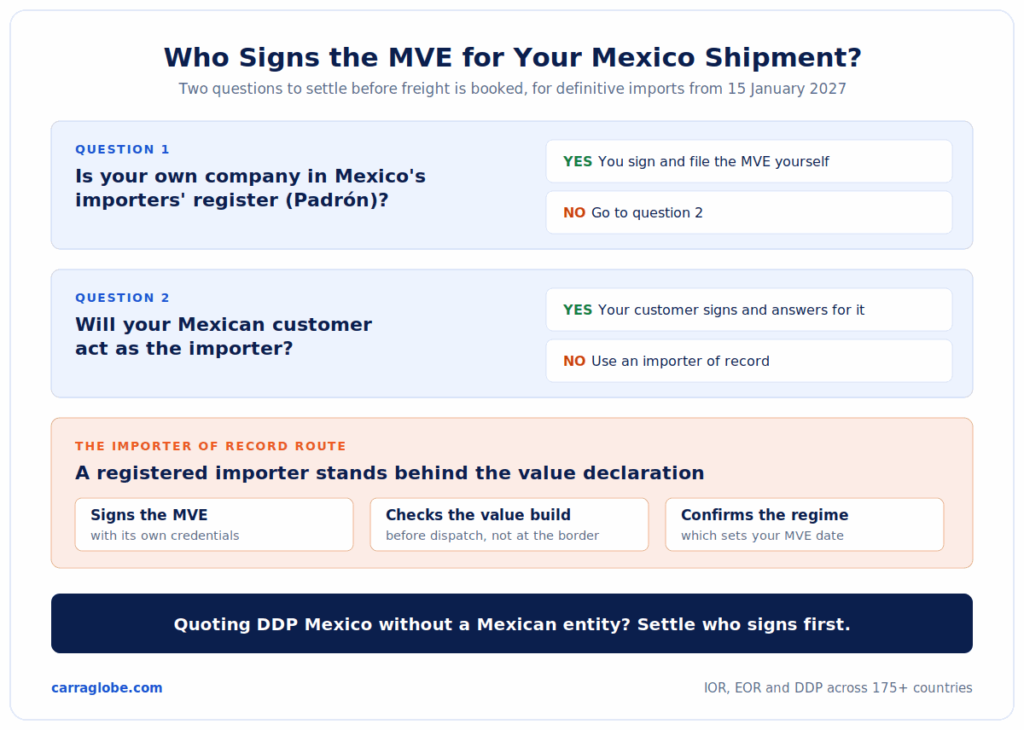
The importer is responsible for the MVE. It signs and transmits the declaration with its own credentials, its SAT e.firma or, where VUCEM accepts it, its own VUCEM digital seal certificate. A customs broker or agency may prepare, review and support the filing, but its role does not replace the importer’s responsibility for the value declared. Our comparison of an importer of record and a customs broker sets out where each role starts and stops.
A foreign company usually cannot simply log in. In July 2026, PRODECON, the taxpayer ombudsman, published SAT’s answer for foreign companies without a permanent establishment using bonded warehouses. Without an e.firma or digital seals, they must act through a legal representative or customs agency. That answer covers one regime only.
Definitive imports add a registration test. The Customs Law requires importers to be in the importers’ register (Padrón de Importadores), and SAT’s requirements start with an active Mexican tax ID (RFC).
That is where DDP quotes break. A seller can promise delivery duty paid, but a registered importer still has to stand behind the MVE. If your customer will not take that role, the options are a Mexican entity of your own or an importer of record. The trade-offs are covered in DDP versus importer of record and in what to do when the customer will not be the importer of record.
Which shippers this affects, from global vendors to single boxes
The size of the shipment does not change who must sign. A rack of servers and a box of two laptops raise the same question.
| Who is shipping | Where the MVE problem appears | What usually works |
|---|---|---|
| Vendor or OEM selling DDP to Mexican customers | The customer will not import, and the vendor has no RFC | An importer of record |
| IT reseller, integrator or MSP on a project | A one-off delivery of firewalls, switches or access points with no local entity | An importer of record for the project, including small shipments |
| Company sending its own kit to a Mexican office or data centre | No sale price, so the value still needs a valuation method | An importer that can support imports where no sale takes place |
| Small firm or individual sending laptops to someone in Mexico | Depending on value and how the courier enters it, a named importer may still be needed | Confirm the entry route before dispatch, not at the border |
What a clean MVE needs from your side
Most problems start in the documents the seller sends. Article 81 of the Customs Law Regulations lists the value-supporting documents. The set below is the usual one, so include what applies to your transaction and make sure every document matches the pedimento and the MVE.
- A commercial invoice that states the real value, with model numbers and quantities matching the packing list. The HS code for routers and switches or the HS code for servers should match the description too.
- A breakdown of the costs added to value, such as freight and insurance to Mexico, where they apply.
- Proof of payment, where there is a sale.
- Transport documents, and certificates of origin only where you claim a preference, such as under USMCA, which our USMCA review guide covers.
- Any contracts behind the transaction, such as supply, distribution or licence agreements.
- A valuation basis for no-sale or used equipment, since used and refurbished IT equipment rarely has a clean transaction value.
Shipping into Mexico after 15 January 2027 without a Mexican entity? Send Carra Globe the pro forma invoice and packing list, and we will check the value build and name the importer before the goods move. Request a Mexico MVE check.
What happens if the MVE is wrong
The exposure falls on the importer. Incorrect or incomplete value information can bring fines under the Customs Law, and which provision applies depends on the error. The importer may also need to correct the declaration, rectify the pedimento and pay further duty and taxes. A mismatch between the MVE and the pedimento can also trigger customs review, delays and a customs hold on IT shipments.
Value also drives your landed cost. Model the landed cost before you quote, and check whether the 2026 Mexico tariff on Asian goods or the routes in reducing import duty in Mexico affect the line items.
Five questions to ask any Mexico importer of record before January
The MVE turns a nominal importer into an accountable one. Ask any provider these questions, including us. Our guide on how to verify an importer of record provider goes further.
- Who signs the MVE? Ask which Mexican entity acts as importer and holds the Padrón registration and signing credentials.
- Is the broker set up to consult the MVE? If the broker cannot see it, release can stall.
- Who checks the value build before dispatch? The answer should be a named step, not the border.
- How do they handle no-sale, used or temporary equipment? These are where valuation questions arise.
- Which regime will each shipment enter under? The answer sets your MVE date, from 1 November 2026 to 15 January 2027.
How Carra Globe handles Mexico imports under the MVE
We settle the importer and the value before the goods move. Carra Globe acts as importer of record for IT, network and data centre hardware entering Mexico, from enterprise rollouts to single boxes. On one recent project, we brought cloud connector equipment into Mexico and delivered it as 15 boxes to offices in Mexico City, Guadalajara, Zapopan and Monterrey. Across our destinations we clear more than 50 shipments a month, and once a client approves a quote we can onboard and act as importer the same day.
Country details sit on our Mexico importer of record page. Where equipment later leaves Mexico for repair or redeployment, Carra Globe can act as exporter of record, and larger server and rack programmes run through our data centre solutions.
Carra Globe works through importer-side registrations and local importing structures appropriate to the goods and destinations it accepts, its own in some markets and established local structures in others. Approvals falling outside the available structure are flagged before a delivery date is agreed.
If you are shipping hardware into Mexico, send us the pro forma invoice, the packing list, the delivery addresses and the date the goods need to arrive. Reach us at info@carraglobe.com.
Mexico · MVE · Importer Of Record
No Mexican RFC? Someone still has to sign the value declaration.
From 15 January 2027 every definitive import into Mexico carries an electronic value declaration signed by the importer. So the useful conversation is who signs it, whether your invoice and costs support the value, and which regime each shipment enters under. Where something sits outside the structure available, you hear that before a delivery date is agreed.
- Global IOR for technology OEMs
- IOR for VARs and technology resellers
- IOR for system integrators
- Who is liable when a reseller imports
- How to choose an importer of record
- What an importer of record costs
- How late you can appoint an IOR
- If your IOR provider goes bust
- Freight forwarder or importer of record
- Power of attorney for customs
- Wrong HS code on the invoice
- Delivery documentation for imports
- ATA carnet, temporary bond or IOR
- Multi-country IT equipment rollouts
- Exporter of record in Mexico
Free tools HS Code Finder Volumetric Weight Calculator Pallet Calculator
Shipping servers, network kit or laptops into Mexico? Send the pro forma invoice, packing list, delivery addresses and arrival date. We will come back on who acts as importer, what the MVE needs and where the timing risk sits.
Check my Mexico shipmentFrequently asked questions
When does the Mexico electronic value declaration become mandatory?
It phases in by customs regime from 1 November 2026. Temporary imports follow on 1 January 2027 and definitive imports on 15 January 2027, under the September 2026 RGCE amendment.
Can a foreign company file the MVE without a Mexican RFC?
Generally not directly. For foreign companies without a permanent establishment using bonded warehouses, SAT has said they must act through a legal representative or customs agency, and definitive imports need a registered importer.
Who is responsible if the MVE is wrong?
The importer. Depending on the error, it may need to correct the declaration, rectify the pedimento and pay fines under the Customs Law plus any further duty and taxes.
Does the MVE apply to temporary imports?
Yes, from 1 January 2027 under the new calendar. Rule 1.5.1 of the RGCE excludes certain temporary imports listed in Article 106 of the Customs Law, so check your case.
What documents support the MVE?
The commercial invoice, proof of payment, transport and insurance documents, origin documents and contracts, as listed under Article 81 of the Customs Law Regulations, all matching the pedimento.
Do I need an importer of record to ship DDP to Mexico?
If neither you nor your customer has a Mexican entity in the importers’ register, usually yes. A registered importer has to stand behind the MVE and the customs entry.
Adjacent ground: what an importer of record does, how to compare DDP quotes for IT equipment and importing IT equipment without a local entity.
Sources and verification
Checked against Mexican government announcements and the legal provisions below on 15 October 2026.
- The extension. SAT, ANAM and ATDT joint announcement of 2 October 2026, extending the transition to 31 October 2026 and setting the phased dates.
- The rule change. First advance version of the Third Resolution amending the 2026 RGCE, posted by SAT on 30 September 2026 pending publication in the Diario Oficial, amending the Eleventh Transitory Article of the RGCE published in the Diario Oficial de la Federación on 27 December 2025.
- The legal basis. Customs Law Article 59, sections III, IV and V, Article 106, Article 81 of the Customs Law Regulations, Article 27 of the IVA Law, and RGCE 2026 rules 1.5.1 and 1.9.16.
- Foreign residents. PRODECON publication of July 2026 reporting SAT’s answer on foreign residents without a permanent establishment under the bonded warehouse regime.
- Signing. VUCEM user manual for registering the value declaration.
- Verification note. The MVE dates have moved several times in 2026, so check SAT’s current position before relying on any date here. Nothing here is advice on your shipments.
Disclaimer: This guide is for informational purposes only and does not constitute legal, customs or tax advice. Mexican customs rules and MVE deadlines can change at short notice. The position described is as at 15 October 2026. Confirm the current position for your shipment with SAT, ANAM or your importer of record before shipping.