
Ask a project manager why a hardware rollout slipped and the flight is rarely the answer. On the shipments we handle, the delay has often started weeks earlier, when nobody checked whether the model was approved in the destination. Certification lead times are the part of an import that freight cannot buy back. This guide sets out what we have actually seen across 21 markets, drawn from more than 6,000 shipments handled by Carra Globe and its team, alongside what each regulator publishes itself.
The short version. On our shipments, a new model has taken from one week to around 12 weeks to approve, depending on the market. Once a model is approved and the paperwork matches, customs clearance has typically taken one to five working days. Among the 21 markets we track, our longest approval ranges were in Brazil, South Africa, Indonesia and Cambodia. Some markets also require a locally established applicant, certificate holder or licensed importer, which can decide who is able to import the goods at all.
Carra Globe provides importer of record, exporter of record, delivered duty paid and freight forwarding services, so we have a commercial interest in your answer. What follows is written to be usable whether or not you ever speak to us.
Two clocks run on every shipment
The approval clock runs before the goods move. It starts when the work on a new model’s approval begins and stops when the certificate is in hand. Testing, document preparation, local representation and the regulator’s own review all sit on it. For a model that has never been approved in a market, this is almost always the longer of the two clocks.
The clearance clock runs after the goods land. Once a valid certificate exists and the invoice, model numbers and battery papers line up, clearance on our shipments has usually taken days rather than weeks, although a customs inspection or another control can still extend it. Our wider guide on how long customs clearance takes covers that second clock in depth. This guide is about the first one, and how far ahead it needs to start.
Certification lead times in 21 markets
These are observed ranges, not regulator promises. “New model lead time” is elapsed calendar weeks from the start of the work to receipt of the certificate, or to completed compliance documents on self-declaration routes, and can include testing, document preparation, local representation and the regulator’s review. “Customs clearance” is working days with a valid certificate and complete, consistent documents. Shipment counts are rounded totals handled by Carra Globe and its team, not certification applications. Most moved under existing approvals, so the approval ranges come from a smaller set, and our evidence is deeper in higher-volume markets.
| Market | Approvals that may apply | Observed new model lead time | Observed customs clearance | Our shipments |
|---|---|---|---|---|
| India | BIS registration, MTCTE, WPC equipment type approval | 2 to 8 weeks | 2 to 3 days | 100+ |
| China | CCC, SRRC radio type approval | 2 to 6 weeks | 1 to 3 days | 150+ |
| Japan | Radio Act conformity, PSE for adapters and batteries | 2 to 8 weeks | 1 to 3 days | 50+ |
| South Korea | KC conformity assessment | 1 to 6 weeks | 1 to 2 days | 100+ |
| Taiwan | BSMI inspection, NCC type approval | 2 to 8 weeks | 1 to 3 days | 100+ |
| Indonesia | Komdigi telecom equipment certificate | 2 to 12 weeks | 1 to 4 days | 100+ |
| Vietnam | Conformity certification and declaration | 2 to 6 weeks | 1 to 4 days | 150+ |
| Malaysia | MCMC certification through SIRIM QAS | 2 to 4 weeks | 1 to 2 days | 200+ |
| Cambodia | TRC type approval, Qualified Agent certificate | 2 to 12 weeks | 2 to 4 days | 50+ |
| Saudi Arabia | SASO certificate through SABER, CST approval | 2 to 8 weeks | 2 to 3 days | 250+ |
| UAE | TDRA type approval | 1 to 2 weeks | 1 to 2 days | 500+ |
| Turkey | TAREKS import inspection, BTK | 2 to 4 weeks | 2 to 3 days | 150+ |
| Kenya | CA type approval, CED licence | 2 to 4 weeks | 1 to 3 days | 100+ |
| Nigeria | NCC type approval, SONCAP | 2 to 5 weeks | 2 to 3 days | 200+ |
| South Africa | ICASA type approval, NRCS letter of authority | 4 to 12 weeks | 1 to 2 days | 300+ |
| Brazil | Anatel homologation | 6 to 12 weeks | 2 to 5 days | 200+ |
| Mexico | Telecom homologation, NOM safety | 2 to 8 weeks | 2 to 3 days | 500+ |
| United States | FCC equipment authorisation | 1 to 2 weeks | 1 to 2 days | 1,500+ |
| Canada | ISED certification, ICES declaration | 1 to 2 weeks | 1 to 2 days | 500+ |
| European Union | CE under the radio, EMC and low voltage directives | 1 to 2 weeks | 1 to 2 days | 500+ |
| United Kingdom | UKCA, or CE where recognised | 1 to 2 weeks | 1 to 2 days | 300+ |
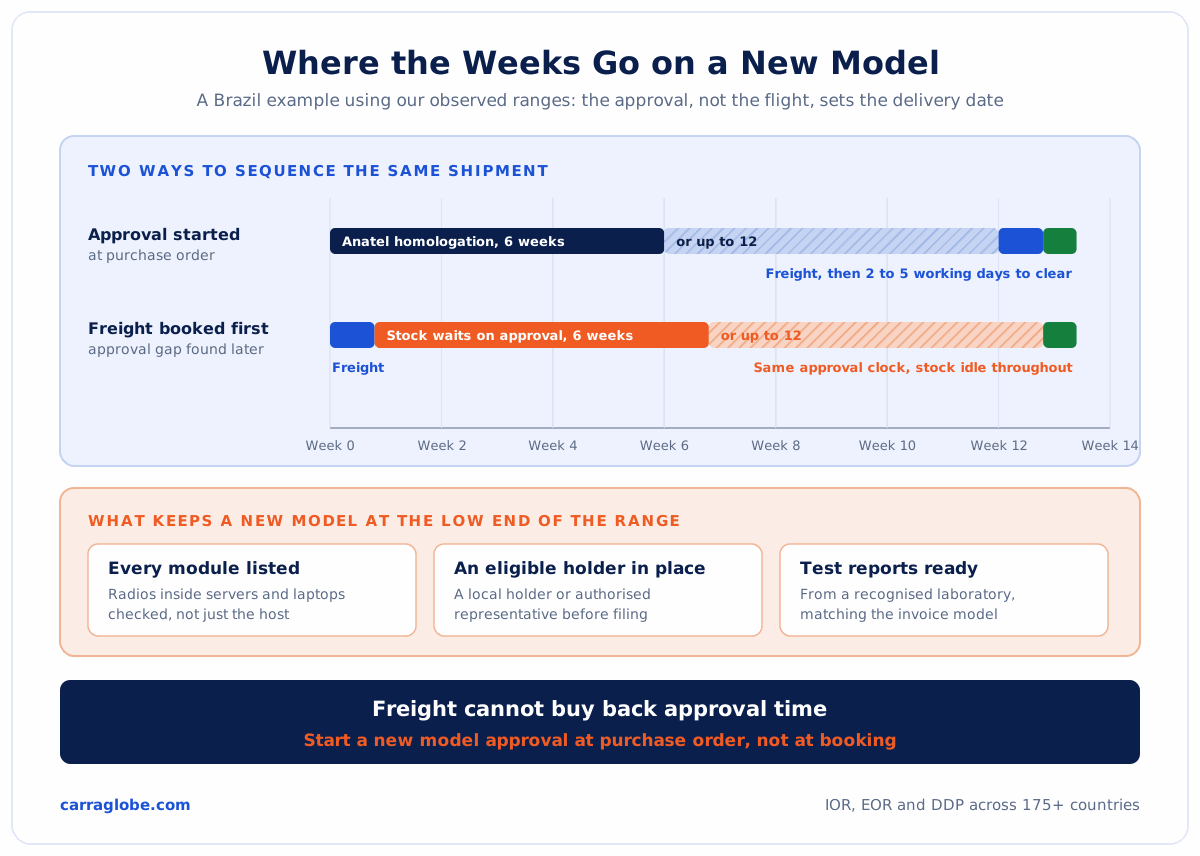
How to read the ranges. The low end is a straightforward model with test reports ready and a holder already in place. The high end reflects lab queues, a new standard, a missing local holder or documents sent back for correction. If your model is already approved in a market, plan on the clearance column. If it is not, plan on the lead time column and add your freight time on top.
What changed in 2026
- Brazil, 25 May 2026. Anatel Act 18086 set import procedures for products subject to Anatel homologation. It is not a blanket certification rule for all IT equipment.
- Vietnam, 1 July 2026. Circular 36/2026/TT-BKHCN from the Ministry of Science and Technology replaced the earlier telecoms product lists with a risk-based list. Certain Wi-Fi access points and modems fall in the high-risk tier, which requires certification by a designated body. Certificates issued before 1 July 2026 remain valid until their stated expiry, so check new models against the new list. See our importer of record in Vietnam page.
- Kenya, 2026. Importers and wholesale distributors of communications equipment need a Communications Equipment Distributor licence, and the latest published type approval regulations set a 30-day decision period. Type approval covers the equipment and the licence covers the importer or distributor, so check which apply to your role.
- Lithium batteries, 1 January 2026. A 30% state of charge cap now applies to most lithium-ion batteries packed with equipment, set out in the holds section below.
- European Union, from 11 December 2027. Delegated Regulation (EU) 2026/339 repeals the radio cybersecurity rules applied since 1 August 2025 from that date, when the Cyber Resilience Act’s requirements apply. Equipment placed on the market before then remains subject to the existing rules.
Why the regulator’s clock and ours differ
A regulator’s clock starts when it accepts a complete file. Testing at a recognised laboratory, translation and appointing a local holder can all happen before then, but they sit inside our ranges, which is why real-world lead times run longer than published ones. Some regulators publish only an upper limit, and some publish no processing time at all.
| Market | What the regulator publishes | Who can hold or apply |
|---|---|---|
| India | BIS registration 20 working days | The manufacturer, with an Indian representative for overseas makers. MTCTE needs an Indian OEM or authorised Indian representative |
| China | CCC generally within 90 days of acceptance. SRRC decision 15 working days after acceptance, testing excluded | Producer, seller or importer for CCC |
| Taiwan | No processing time found | For imports, an agent or importer with a domicile or business place in Taiwan |
| Indonesia | Complete applications checked in one working day | Brand holder, appointed representative or distributor, contract manufacturer |
| Malaysia | Import permit up to 24 working hours | A Malaysian company registered with SSM, and permits are not transferable between importers |
| Cambodia | Type approval 15 business days, import permit generally 3 | Only a Qualified Agent registered in Cambodia |
| Saudi Arabia | SABER certificate registration 5 to 6 working days | Manufacturer, local agent or importer |
| UAE | Supplier registration one working day | A TDRA-registered supplier. Other importers need the holder’s authorisation |
| Kenya | Decision within 30 days of a complete application, under the 2026 regulations as published | Importers and wholesale distributors need a CED licence |
| Nigeria | NCC type approval 30 days, SONCAP certificates within 96 hours | Corporate bodies, and NCC says a local representative is not mandatory |
| South Africa | ICASA’s current page says usually 30 days once all documents are in, while its separate 2013 guidelines say 15 working days | South African registered companies only |
| Brazil | No processing time found | For homologated products, commercial imports by the holder or its legal representative, per published summaries of Act 18086 |
| Mexico | The former IFT’s published timelines are no longer reachable online, so verify the current CRT procedure | Confirm with the CRT, which took over telecoms regulation under the 2025 law |
| United States | No processing time set | A US-based responsible party for a supplier’s declaration, and a US agent for certified radios |
| European Union | Self-declaration may be available where the relevant harmonised standards are fully applied, otherwise a notified body route | An EU-established economic operator for market surveillance, which need not be the importer of record |
The holder column matters more than the time column. Where a scheme requires a locally eligible applicant or certificate holder, plan for it from the start, because whether that holder can import itself or authorise another importer depends on the market. See how to import IT equipment into Brazil without a local entity, India without a local entity and Saudi Arabia without a local entity, and our guides to SASO 3114 certificates in Saudi Arabia and NOM certification for IT hardware in Mexico.
Where the longest waits sit
Brazil has the widest range at the top, 6 to 12 weeks. For products subject to Anatel homologation, Act 18086 of 25 November 2025, in force since 25 May 2026, sets separate procedures by import purpose, covering homologated products for use or sale, own use, conformity samples and demonstration. Published summaries of the Act, including the US International Trade Administration’s, say commercial imports of homologated products are restricted to the homologation holder or its legal representative. Confirm the procedure for your shipment before it leaves. See our importer of record in Brazil page.
South Africa’s range starts at four weeks. ICASA issues type approval only to South African registered companies, and its approval is tied to brand, model and specification. Products under a compulsory specification may also need a letter of authority from the NRCS. See our pages on the importer of record in South Africa and South Africa’s IOR rules for tech imports.
Indonesia and Cambodia can stretch to 12 weeks. Under Indonesia’s 2024 regulation, the telecom equipment certificate itself has no time limit, but the holder may make, assemble or import the covered equipment for only three years from issue. To continue after that, Article 18 requires new testing and a new certificate. Local content rules can add a separate layer, explained in our TKDN guide. Cambodia lets only a Qualified Agent hold type approval, covered in our guide to the Cambodia TRC Qualified Agent certificate.
Where approval is quickest
Approval is quicker where no new third-party certificate is needed. Our one-to-two-week ranges reflect the cases we have handled, not every new model, because each route depends on the equipment, its radios, the standards applied and any existing approvals.
- United States. Servers and other digital devices may use a supplier’s declaration with a US-based responsible party. Most Wi-Fi or Bluetooth devices are intentional radiators that need certification through a recognised certification body. See our importer of record in the USA page.
- Canada. Radio apparatus needs ISED certification, while computers and other interference-causing equipment follow a supplier’s declaration under ICES-003. The two routes are not interchangeable. See our importer of record in Canada page.
- European Union. Under the Radio Equipment Directive, the conformity route depends on the applicable requirements and standards used. Internal production control may be available where the relevant harmonised standards are fully applied, otherwise a notified body may be needed. Cybersecurity rules for specified radio equipment still apply, and products under the radio, EMC and low voltage directives need an EU-established economic operator, who is not automatically the importer of record, covered in our guide to CE marking importer obligations.
- United Kingdom. Great Britain continues to recognise CE marking for the product regulations covered by the government’s recognition policy, with no end date currently set.
- UAE. Approval moves quickly once a supplier is registered with TDRA, but ownership does not transfer, so a second importer needs the holder’s authorisation. See our importer of record in the UAE page.
Planning a rollout across several of these markets? Send Carra Globe your model list and destinations, and we will tell you which approvals each model needs, who must hold them, and the lead time to plan around. Request a certification check.
Why approved shipments still get held
A certificate on file does not guarantee a clean entry. Across our shipments, four problems come up most often on goods that were otherwise approved.
- A radio module outside the approval. A server or laptop is approved, but its Wi-Fi or Bluetooth module falls outside that approval’s scope or needs its own. We see this most in India, Cambodia, Vietnam, Saudi Arabia, Pakistan, Sri Lanka and Myanmar.
- A certificate the importer cannot use. The approval sits with the manufacturer or another importer and does not transfer. This comes up most in Saudi Arabia, India, Pakistan and Bangladesh.
- A model number that does not match. The invoice shows a model or variant different from the certificate. We see this most in Brazil, Colombia, Peru and Argentina.
- Missing lithium battery papers. This recurs on battery-containing shipments across all our lanes.
Battery rules tightened on 1 January 2026. Under IATA guidance, lithium-ion batteries packed with equipment (UN3481, Packing Instruction 966) must generally ship at no more than 30% state of charge, with shipments above that allowed only under specific approvals from the states of origin and of the operator. Under Section II, batteries of 2.7 Wh or less are only recommended to meet it. For batteries contained in equipment (Packing Instruction 967), 30% is a recommendation.
A test summary, not a data sheet. Manufacturers and later distributors must make a UN 38.3 test summary available, which need not travel with every shipment, while a safety data sheet is a carrier expectation, not a dangerous goods rule. See our lithium battery customs clearance guide.
Mismatches are cheaper to fix before departure. Check the model number on the invoice against the certificate, and the HS code for routers and switches or for servers against the declaration. If something is already held, our guide to resolving customs holds on IT shipments sets out the next steps, and our note on a customs hold on servers covers the most common case.
A five-step certification plan
- List every model and module, including radios inside servers, laptops and access points, and any batteries shipped loose.
- Check approval status per market on the regulator’s public register where one exists, and confirm who holds each certificate.
- Confirm the holder can import for you, or arrange a local holder where the market requires one.
- Start new approvals at purchase order, using the new model column above, before you book freight, especially on a first shipment to a new country.
- Match the paperwork so invoice model numbers, certificates and battery documents agree, then build the timing into your landed cost and multi-country deployment plan.
How Carra Globe handles certification-led shipments
We check approvals before we accept a shipment, not after it lands. Carra Globe acts as importer of record for IT, data centre and network hardware. In Malaysia we can apply for and hold SIRIM and MCMC certificates as the local holder, set out on our Malaysia SIRIM compliance page. Our partner in Kenya holds a Communications Equipment Distributor licence, our Cambodian partner holds a TRC Qualified Agent certificate, and our Mexican partners hold NOM certificates.
Carra Globe works through importer-side registrations and local importing structures appropriate to the goods and destinations it accepts, its own in some markets and established local structures in others. Approvals falling outside the available structure are flagged before a delivery date is agreed.
When equipment later leaves a market, Carra Globe can act as exporter of record. Wider coverage across 175+ countries is on our IOR by country page.
For a certification check, send us your draft commercial invoice, model datasheets, destinations, battery documents and the date the goods need to arrive. Reach us at info@carraglobe.com.
Certification · 21 Markets · Importer Of Record
Send the model list. We will tell you which approvals each market needs and how long to allow.
On our shipments, a new model has taken from one week to around 12 weeks to approve, and in several markets the certificate has to sit with a locally eligible holder. So the useful conversation is which models are already approved, who holds each certificate, and whether that holder can import for you. Where something sits outside the structure available, you hear that before a delivery date is agreed.
- IOR for telecom equipment
- When a lab test report is rejected
- Encryption rules for network kit
- Thailand NBTC and TISI approvals
- SONCAP certification in Nigeria
- EU Cyber Resilience Act for importers
- IOR for data centre equipment
- How late to appoint an IOR
- Global IOR for technology OEMs
- IOR for system integrators
- IOR for VARs and resellers
- Importer of record in India
- Importer of record in Saudi Arabia
- Importer of record in Mexico
- Importer of record in Malaysia
Free tools HS Code Finder Volumetric Weight Calculator Pallet Calculator
Planning a rollout across several markets? Send the model numbers, radio modules, destinations, battery documents and your arrival dates. We will come back on the approvals each model needs, who must hold them and the lead time to plan around.
Check my certification lead timesFrequently asked questions
How long does IT hardware certification take?
On our shipments, a new model has taken from one week in the US, Canada, the EU and the UK to around 12 weeks in Brazil, South Africa, Indonesia and Cambodia.
How fast does customs clear an approved model?
Typically one to five working days in the 21 markets we track, provided the invoice, certificate and battery documents match.
Can an importer use the manufacturer’s certificate?
Not always. Malaysia does not transfer permits between importers, the UAE needs the holder’s authorisation, and Brazil’s Act 18086, as summarised, restricts commercial imports of homologated products to the holder or its legal representative.
When should certification start for a rollout?
At purchase order for any model that is new to a market. For Brazil, South Africa, Indonesia and Cambodia, that can mean around 12 weeks before goods need to arrive.
Why do certified shipments still get held?
Most often because a radio module is unapproved, the certificate belongs to someone else, the invoice model number differs, or lithium battery papers are missing.
Is a safety data sheet required to fly lithium batteries?
Not under the dangerous goods rules, though carriers and forwarders usually ask for one. A UN 38.3 test summary must be made available for lithium-ion batteries.
Adjacent ground: IT hardware import compliance by country, India BIS registration for data centre equipment, what an importer of record does and product certification when manufacturing moves.
Sources and verification
Lead times, clearance times and shipment counts are Carra Globe’s own, covering shipments handled by Carra Globe and its team. Regulatory points were checked against official publications on 26 October 2026.
- India. BIS Citizen’s Charter (January 2024) for the 20 working day registration timeline, the BIS Scheme II registration page, BIS frequently asked questions on compulsory registration and the TEC MTCTE procedure, version 3.0.
- China. Provisions on Compulsory Product Certification and MIIT Order No. 57 on radio transmission equipment type approval.
- Japan, South Korea and Taiwan. MIC technical regulations conformity, METI PSE guidance, the Korea RRA conformity assessment annex published by NIST, and Taiwan’s BSMI procedures for registration of product certification.
- Indonesia and Vietnam. Ministerial Regulation No. 3 of 2024 on telecom equipment certification, Komdigi service standard and Vietnam’s Circular 36/2026/TT-BKHCN, effective 1 July 2026.
- Malaysia and Cambodia. WTO import licensing notifications for Malaysia’s telecommunication apparatus and Cambodia’s TRC procedures.
- Saudi Arabia and UAE. SASO technical regulation for communications and IT devices, the SASO certificate registration service, the TDRA Type Approval Policy, version 4.0 and TDRA supplier registration.
- Turkey, Kenya and Nigeria. The Ministry of Trade guidance on TAREKS inspection, Kenya’s Type Approval of Electronic Communications Equipment Regulations, 2026 as published by the ICT ministry (regulation 11(2)), the ministry’s 2026 regulations list, the Communications Authority of Kenya type approval form, the CA market structure, NCC type approval FAQs and SON’s SONCAP frequently asked questions.
- South Africa. ICASA Type Approval Regulations and ICASA Type Approval Guidelines and ICASA type approval page.
- Brazil and Mexico. Anatel product certification, Anatel Act 18086 of 25 November 2025, the US International Trade Administration note on Anatel Act 18086 and Mexico’s Telecommunications and Broadcasting Law.
- United States and Canada. 47 CFR 2.909, 47 CFR 15.101, 47 CFR 15.201, ISED’s equipment certification overview and ICES-Gen.
- EU and UK. The Radio Equipment Directive, the European Commission RED page, Delegated Regulation (EU) 2026/339, the Market Surveillance Regulation and GOV.UK guidance on UKCA and CE marking.
- Lithium batteries. IATA Lithium Battery Guidance Document (2026) and the FAA Lithium Battery Shipping Guide.
- Verification note. Regulators change scope, fees and procedures often, and our ranges reflect past shipments rather than future ones. Check the current position before relying on this guide. Nothing here is advice on your shipments.
Disclaimer: This guide is for informational purposes only and does not constitute legal, customs or certification advice. Approval requirements, lead times and holder rules depend on the specific product, its configuration and the parties involved. Lead times shown are ranges observed on past shipments and are not guaranteed. The position described is as at 26 October 2026. Confirm the current position with the relevant regulator or your importer of record before shipping.