
NOM certification in Mexico starts with a question most IT shippers skip. The issue is not whether a product has a certificate, but which NOMs apply to that exact model, who holds them, and how the goods will be labelled. That question got sharper on 28 September 2026, when the Ministry of Economy (SE) added five telecom tariff lines to the goods checked at the border against Mexico’s mobile terminal standards, starting 30 business days after publication, roughly six weeks later.
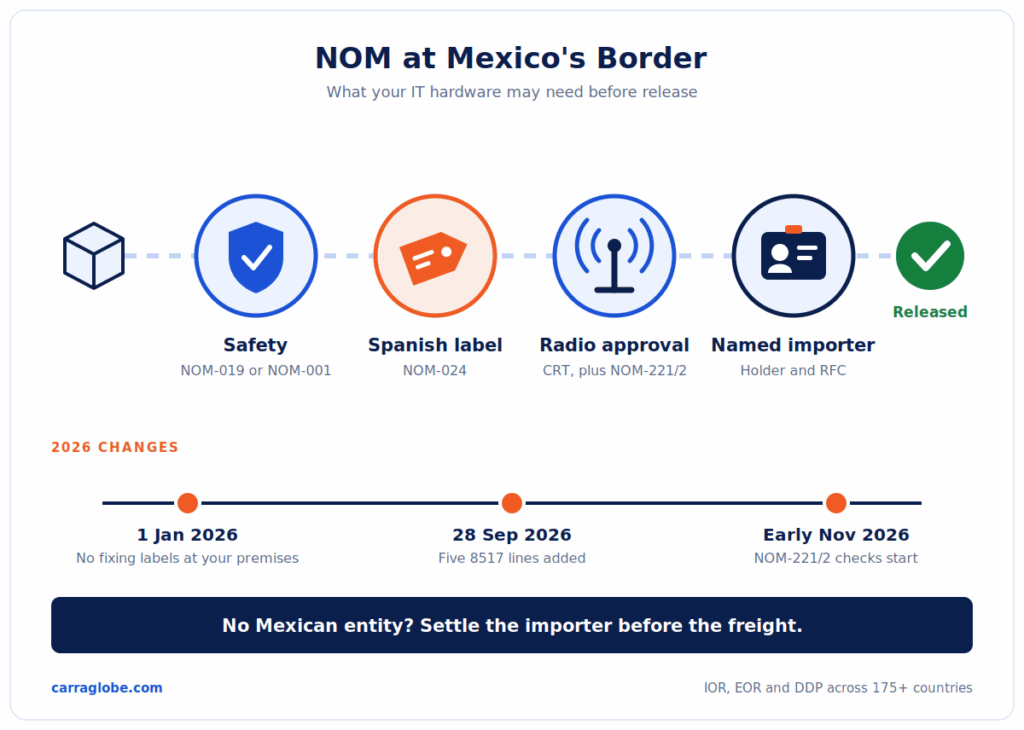
The short version. NOMs are Mexico’s mandatory technical standards, and customs checks them by tariff line under Annex 2.4.1. Depending on the model, IT hardware may need NOM-019-SCFI-1998 or NOM-001-SCFI-2018 for safety and NOM-024-SCFI-2013 for Spanish commercial information, while the new border check covers mobile terminals, mainly under NOM-221/2. Telecom homologation is a separate approval. Before shipping, settle the legal importer, the certificate holder and the labelling arrangement, which is where sellers with no Mexican entity usually need help.
Carra Globe provides importer of record, exporter of record, delivered duty paid and freight forwarding services, so we have a commercial interest in your answer. What follows is written to be usable whether or not you ever speak to us.
How NOM certification in Mexico works at the border
Customs checks NOMs by tariff line, not by product name. Annex 2.4.1 of the Ministry of Economy’s foreign trade rules lists the tariff lines that must show NOM compliance at the point of entry, so your HS code for routers and switches or HS code for servers decides which NOMs customs asks about.
A listed line does not mean every model is in scope. Each NOM sets its own scope, so check the model against the standard itself. A certification body’s opinion can support a scope position, but it does not override a requirement that applies. Get this wrong and the result is usually a customs hold on IT shipments.
Which NOMs may apply to IT and network hardware
Several NOMs may need assessing for one IT shipment. The answer depends on the model, its classification, its intended use and how it is sold.
| Standard | What it covers | What to know |
|---|---|---|
| NOM-019-SCFI-1998 | Safety of specified data processing and communication equipment | Covers specified data processing and related communication equipment, including certain uniprocessor computers and peripherals. It excludes multiprocessor architecture and several kinds of specialised enterprise, scalable, fault-tolerant or high-performance systems, plus communication equipment that is modular, programmable or above set bus speeds. Check the model, not the marketing label |
| NOM-001-SCFI-2018 | Safety of mains-powered electronic equipment | May apply to electronic products within its scope that another NOM does not cover, including external power supplies used with NOM-019 IT equipment. It excludes equipment within NOM-019-SCFI-1998, products subject to a more specific NOM, external supplies above 250 W and UPS units of 10,000 VA or more. Do not assume it applies just because a product has a plug |
| NOM-024-SCFI-2013 | Spanish commercial information, user guide and warranty for consumer products | Highly specialised equipment not sold directly to the public, not for domestic use and supplied under a contract covering commercial information, warranty and installation can be relieved of labels and instructions. Enterprise sales alone do not prove a product qualifies |
| NOM-221-SCFI-2017 | Mobile terminals, covering IMEI and FM receiver functionality | Applies to mobile terminal equipment. Under the September 2026 change, it is added only for tariff line 8517.18.99 |
| NOM-221/2-SCFI-2018 | Technical specifications for mobile terminals in listed radio bands | Applies to mobile terminals using the 700 MHz to 2500 MHz bands it lists. Under the September 2026 change, it is checked for all five new tariff lines |
| Telecom homologation | Equipment that connects to networks or uses radio spectrum | Separate from NOM, now overseen by the Telecommunications Regulatory Commission (CRT), which took over from the IFT |
Some products need no NOM at all. A model outside every applicable NOM scope may need no certificate, but record that conclusion from the standard’s scope, the tariff line and the product specification, not from a supplier’s email.
Radio, encryption and batteries add their own checks. Wireless access points need telecom homologation as well as any applicable NOM, products with strong cryptography may raise encryption import questions, and units with built-in batteries bring lithium battery clearance rules.
The September 2026 change, NOM-221 and NOM-221/2 at the border
Five telecom tariff lines now need proof on entry. The Ministry of Economy’s agreement, published in the Official Gazette on 28 September 2026, adds 8517.13.01, 8517.14.91, 8517.18.99, 8517.62.17 and 8517.69.99 to Annex 2.4.1 for NOM-221/2-SCFI-2018, and adds NOM-221-SCFI-2017 for 8517.18.99 only. The rest of the agreement applied from 29 September, while these checks start 30 business days after publication, in the first half of November 2026.
Both standards are written for mobile terminals. A fixed router or switch classified under 8517.62.17 is unlikely to be a mobile terminal, but a device with a cellular radio may be. A device shipped under 8517.62.17 faces NOM-221/2 only, not NOM-221, so confirm which standard, if any, covers each model, and remember that homologation does not replace NOM-221/2 conformity where it applies.
Importer, certificate holder and label, and why foreign sellers get stuck
Three roles need settling before shipment. The legal importer answers for the entry. The certificate holder depends on the NOM and the certification scheme, and whether an existing certificate can be used for another importer depends on its terms, so confirm that with the certification body first. Where NOM-024 applies, the Spanish label and documents carry Mexican importer details.
That makes NOM an importer question as much as a product question. A vendor or reseller with no Mexican entity usually cannot fill those roles itself, so if your customer will not import, you need a Mexican importer that can, the same problem you meet wherever you import IT equipment without a local entity. That importer will usually file the Mexico electronic value declaration from January 2027 too, so settle both together.
Are UL or CSA certificates accepted in Mexico? That depends on the certificate, the issuing body and the product scope. Equivalence agreements published in 2010 recognise certain results from listed US and Canadian bodies, including UL, CSA Group, Intertek and TÜV Rheinland North America, for NOM-019-SCFI-1998 and NOM-016-SCFI-1993 only. They do not satisfy NOM-001, which replaced its 1993 version in August 2020 and left the old equivalence behind, nor NOM-024, NOM-221/2 or telecom homologation. Confirm the current agreement and scope before relying on one.
Plan the labelling route before dispatch
The cheapest label is the one applied before the goods leave. An inspection unit authorised by the Ministry of Economy can prepare compliant labels for the supplier to apply at origin. Labelling in a general deposit warehouse before release has also been used in practice, subject to conditions, so treat it as a route to confirm with your customs broker for your entry.
Fixing labels after arrival has become harder. Where goods arrive without required commercial labelling, rule 3.7.20 of the general foreign trade rules sets a retention procedure in which the importer must show compliance within 30 days and pay a fine. Since 1 January 2026, the option to hold those goods at the importer’s own premises while it fixes them has gone. This procedure is for labelling and commercial information. A missing or invalid safety certificate, a radio homologation gap or another NOM failure may follow a different procedure.
Not sure which NOMs your models need, or who will hold the certificate? Send Carra Globe the model list, HS codes and datasheets, and we will confirm the NOMs, the labelling route and the importer before you book freight. Request a Mexico NOM check.
A five-step NOM check before you ship
- Classify every model and check its tariff line against Annex 2.4.1, including the five 8517 lines added in September 2026.
- Map each NOM to the model using the standard’s own scope, not the tariff list alone.
- Name the importer and certificate holder, and confirm whether an existing certificate can be extended.
- Fix the labelling route, or document why a NOM-024 provision applies.
- Align the paperwork, so certificates, labels, invoice and value declaration describe the same models, and fold certification costs into your landed cost.
Testing questions often follow, and our guide on foreign test reports and lab recognition explains why a report from one country is not always accepted in another. If production is moving between factories, see product certification when manufacturing moves.
How Carra Globe handles NOM on Mexico imports
Our Mexican partner holds NOM certificates and acts as the importer. Carra Globe acts as importer of record for IT, network and data centre hardware entering Mexico, and our partner there supports the product-compliance requirements for the hardware we accept. We confirm the applicable certifications, scope and documents for each shipment before agreeing a delivery date. On one recent project, we delivered cloud connector equipment as 15 boxes to offices in Mexico City, Guadalajara, Zapopan and Monterrey.
Across our destinations we clear more than 50 shipments a month, and once a client approves a quote we can onboard and act as importer the same day. Country details sit on our Mexico importer of record page, and where equipment later leaves Mexico, Carra Globe can act as exporter of record.
Carra Globe works through importer-side registrations and local importing structures appropriate to the goods and destinations it accepts, its own in some markets and established local structures in others. Approvals falling outside the available structure are flagged before a delivery date is agreed.
If you are shipping hardware into Mexico, send us the model list, HS codes, datasheets, delivery addresses and the date the goods need to arrive. Reach us at info@carraglobe.com.
Mexico · NOM · Importer Of Record
Send the model list. We will tell you which NOMs apply and who holds the certificate.
Most Mexico delays on IT hardware start with a label, a certificate in the wrong name or a tariff line nobody checked. So the useful conversation is which NOMs each model needs, which labelling route fits, and which Mexican importer holds or extends the certificate. Where something sits outside the structure available, you hear that before a delivery date is agreed.
- Global IOR for technology OEMs
- IOR for VARs and technology resellers
- IOR for system integrators
- When the customer will not be IOR
- How to verify an IOR provider
- What an importer of record costs
- DDP or importer of record
- CE marking duties for importers
- Importing used and refurbished IT kit
- Wrong HS code on the invoice
- USMCA 2026 review for importers
- Reducing import duty in Mexico
- Importing into Canada without CARM
- Data centre server and rack deployments
- Exporter of record in Mexico
Free tools HS Code Finder Volumetric Weight Calculator Pallet Calculator
Shipping servers, network kit or laptops into Mexico? Send the model numbers with HS codes and datasheets, the delivery addresses and your arrival date. We will come back on the NOMs, the labelling route and who acts as importer.
Check my Mexico shipmentFrequently asked questions
Do servers need NOM certification in Mexico?
It depends on the model. NOM-019-SCFI-1998 excludes certain highly specialised systems, including multiprocessor servers, so check the architecture against its scope rather than the product name.
Who holds the NOM certificate in Mexico?
It depends on the NOM and certification scheme. Whether an existing certificate can serve another importer depends on its terms, so settle importer and holder before shipping.
Are UL or CSA certificates accepted in Mexico?
Only in part. The 2010 equivalence agreements cover NOM-019-SCFI-1998 and NOM-016-SCFI-1993 through listed bodies, not NOM-001, NOM-024, NOM-221/2 or telecom homologation.
Does NOM-221/2 now apply to routers?
Tariff line 8517.62.17 is now checked against NOM-221/2, which covers mobile terminals. A fixed router is unlikely to qualify, while cellular devices need checking.
Is telecom homologation the same as NOM certification?
No. Homologation, now overseen by the CRT, covers network connection and radio use, while NOMs cover areas such as safety and commercial information. Neither replaces the other.
What happens if goods arrive without the required labels?
Customs can retain them under rule 3.7.20 while the importer shows compliance within 30 days and pays a fine. Other NOM failures can follow different procedures.
Adjacent ground: what an importer of record does, importer of record for telecom equipment and Mexico customs rules for high-value tech imports.
Sources and verification
Checked against Mexican government publications and the sources below on 16 October 2026.
- The September change. Ministry of Economy agreement amending Annex 2.4.1, Diario Oficial de la Federación, 28 September 2026.
- Equivalence agreements. Ministry of Economy equivalence agreements for NOM-019-SCFI-1998 and NOM-016-SCFI-1993, published 17 August 2010.
- Standards. NOM-019-SCFI-1998 (scope, sections 1.1 and 1.2), NOM-001-SCFI-2018, NOM-024-SCFI-2013 (section 6.5.1 on highly specialised equipment), NOM-221-SCFI-2017 and NOM-221/2-SCFI-2018, as published on the Ministry of Economy’s standards platform, with NOM-001-SCFI-2018 (section 1 on objective and scope, including sections 1.2 and 1.3) in force since 14 August 2020 after a three-month deferral, in place of NOM-001-SCFI-1993, and the Programa Nacional de Infraestructura de la Calidad 2026 published 24 February 2026.
- Border enforcement. Annex 2.4.1 of the Ministry of Economy’s foreign trade rules and rule 3.7.20 of the general foreign trade rules on retention for labelling non-compliance, as amended from 1 January 2026.
- Telecom regulator. The Telecommunications and Broadcasting Law in force from 17 July 2025, transferring oversight from the IFT to the CRT.
- Verification note. NOM scope, certificate terms and Annex 2.4.1 change often, so check the current position for each model before relying on this guide. Nothing here is advice on your shipments.
Disclaimer: This guide is for informational purposes only and does not constitute legal, customs or product certification advice. NOM requirements depend on the exact model, tariff classification and sales channel. The position described is as at 16 October 2026. Confirm the current position for your products with an accredited certification body or your importer of record before shipping.