
Every guide to this question gives you an average, and the average is the least useful number in customs. The honest answer to how long does customs clearance take is that there are two answers, not one. If nothing about your shipment raises a flag, clearance is fast: often hours for express and air freight, a day or three for ocean, and frequently completed before the goods even arrive. If something does raise a flag, you are in a different queue entirely, and that queue is measured in days to weeks. There is not much of a middle. The real question is not “what is the average,” it is “which of the two queues will my shipment be in,” and that is decided almost entirely before the shipment moves.
Customs clearance takes from a few hours to about three days for compliant shipments with complete, pre-filed paperwork: express parcels often clear within hours, air freight typically within 24 to 72 hours, and ocean freight within 1 to 5 business days. Shipments that are flagged, examined, or missing something take far longer, from several days to several weeks. Which outcome you get is largely determined before the goods ship.
How Long Does Customs Clearance Take? The Fast Queue vs the Slow Queue
Modern customs systems do not process shipments one by one with a stopwatch. They risk-score them. Entries filed in advance, with clean documentation, a valid importer of record, and nothing unusual about the goods, are released electronically, often before arrival, with no human ever touching the file. That is the first queue, and the large majority of compliant commercial shipments live in it.
The second queue is everything else: entries flagged for examination, missing a filing, showing a vague description, lacking a required approval, or naming an importer the system does not trust. These do not take “a bit longer.” They stop, wait for a human, and restart. Averaging the two queues produces a number that describes neither, so this guide gives you both baselines, then the exact triggers that move a shipment from one queue to the other and what each costs.
The Fast Queue: Baseline Clearance Times by Mode
These are realistic baselines for compliant shipments with complete documentation filed before arrival. They vary by port, season, and country, but they are the right planning numbers for the fast queue.
| Mode | Typical Clearance (Compliant, Pre-Filed) | Notes |
|---|---|---|
| Express courier | A few hours to 1 day | Automated screening; documents often clear same day |
| Air freight | 24 to 72 hours | Frequently pre-cleared while the aircraft is inbound |
| Ocean FCL | 1 to 3 business days | Entry can be filed and released before the vessel docks |
| Ocean LCL | 2 to 5 business days | Deconsolidation adds a step, and you share the container’s risk profile |
| Road (cross-border) | Hours to 1 day | Depends heavily on the specific border and pre-lodgement |
Notice what these numbers assume: the entry was filed before arrival. In the fast queue, release often exists before the shipment does. Who carries that preparation depends on the incoterm: under DDP the seller owns the whole clearance, covered in our guide to DDP customs clearance worldwide. And if you are reading this with a shipment already stuck, skip to our guide on resolving and preventing customs holds.
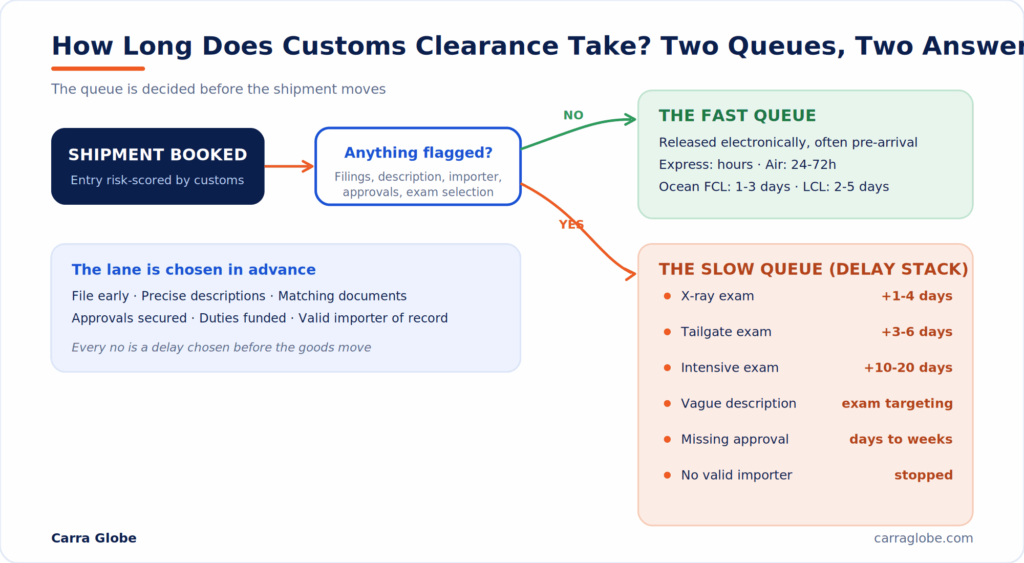
The Delay Stack: What Each Trigger Actually Costs You
This is the table the generic guides never publish. Each row is a specific trigger that moves a shipment into the slow queue, the time it typically adds, and the prevention. The stakes rose in 2026: customs authorities in the US and elsewhere have intensified scrutiny of origin, valuation, and forced-labour compliance, so descriptions and declarations that would have passed quietly a few years ago now invite examination. The times are realistic industry ranges, not promises; a congested port or a bad week can stretch any of them.
| Trigger | Time It Typically Adds | Prevention |
|---|---|---|
| Non-intrusive exam (X-ray scan) | 1 to 4 days | Largely random, but precise goods descriptions reduce targeting |
| Tailgate exam (seal broken, visual check) | 3 to 6 days | Consistent documents that match the physical cargo |
| Intensive exam (container fully unloaded) | 10 to 20 days, plus fees | Clean compliance history; avoid vague descriptions and undervaluation |
| Missing or late security filing (ocean) | Days, plus penalties | File well before vessel loading, not at the deadline |
| Vague goods description (“parts”, “equipment”) | Days, via exam targeting | Describe precisely: what it is, what it is for |
| No valid importer of record | Stopped until resolved | Confirm a compliant importer before the goods ship |
| Missing regulatory approval (health, telecom) | Days to weeks, separate from customs | Secure registrations and type approvals pre-shipment |
| Dangerous goods paperwork gaps (batteries) | Refusal or hold at carrier or border | Valid UN 38.3 summary, correct marks and packaging |
| First-time or non-resident importer | Extra review on early entries | Register properly, or use an established importer of record |
| LCL co-loading (someone else’s problem) | Days, outside your control | Ship FCL for critical cargo, or vet the consolidation |
Read the table’s worst rows again: they are not delays, they are stops. A missing importer, approval, or filing does not add days to a timer; it halts the clock until someone fixes it. And most of those rows trace to one role, the importer of record: in the US, a foreign business must be registered through CBP’s importer identity process before it can clear anything, and 2026 enforcement tightened who may act in that role.
Shipping into a country where you have no local entity? Carra Globe files before arrival, holds the approvals, and clears as your importer of record across 175+ countries.
Which Goods Sit in the Slow Queue More Often?
The delay stack is not evenly distributed across cargo. Three categories attract the slow queue disproportionately, and all three for reasons that have little to do with customs duty.
High-value IT and data centre hardware draws attention because of its value and, since the export-control era began, because of what it is: advanced servers and GPUs invite scrutiny of destination and end use, and a hold on one rack can stall a commissioning date. We cover that specific pain in our guide to a customs hold on servers. Regulated goods, medical devices above all, face a second regulator behind customs: the health authority can hold a device that customs has already released, which is why registration must precede shipping, as set out on our medical devices importer of record page. And lithium batteries carry the dangerous-goods layer, where a missing test summary stops the shipment at the carrier before customs ever sees it, covered in our guide to lithium battery customs clearance.
The Pre-Shipment Lane Check
Fifteen minutes before booking, run the shipment against this list. Every yes keeps you in the fast queue; every no is a delay you are choosing in advance.
- Confirm a valid importer of record in the destination country, with any licences the goods require.
- File early. Lodge security filings and the customs entry well before arrival, not on the deadline.
- Write precise descriptions. Every line says what the goods are and what they are for, no “parts,” no “equipment.”
- Match the documents. Invoice, packing list, and transport document must tell the same story to the unit and the kilogram.
- Secure approvals first. Type approval, health registration, dangerous goods certification, whatever the category needs, before shipping.
- Fund the duties. Put payment arrangements in place so release is not waiting on money.
One item on that list carries stakes beyond a delay: repeated document mismatches invite scrutiny of past entries too, as our guide to documentation errors that trigger customs audits sets out.
Frequently Asked Questions
How long does customs clearance take for air freight?
Typically 24 to 72 hours for compliant shipments, and often faster, because air entries are frequently pre-cleared while the aircraft is still inbound. Express parcels commonly clear within hours.
An exam or documentation problem moves an air shipment into the slow queue like any other, adding days.
How long does sea freight take to clear customs?
Typically 1 to 3 business days for full containers and 2 to 5 for consolidated cargo, if the entry was filed before arrival. Examinations extend this to days or weeks.
Full containers also clear more predictably than LCL, where you share the container’s risk profile with every other shipper in it.
Why is my shipment stuck in customs?
Usually one of five things: an examination, a late or missing filing, a vague goods description, a missing regulatory approval, or an invalid or unregistered importer of record.
Identify which one applies before chasing anyone, because each has a different fix and a different owner. Our customs hold guides walk through the resolution path.
Can customs clearance happen before the shipment arrives?
Yes, and for well-run imports it usually does. Entries can be filed and released in advance, so compliant cargo is effectively cleared before it lands or docks.
Ask your broker or forwarder whether pre-arrival filing is their standard practice; many treat it as optional unless the importer insists.
So, how long does customs clearance take? Hours to a few days if you prepared, days to weeks if you did not. The border does not decide your clearance time; your paperwork, your approvals, and your importer of record decide it, and the border merely reveals the decision. Carra Globe runs that preparation as importer of record for tech and regulated hardware across 175+ countries.
Disclaimer: This guide is for informational purposes only and does not constitute legal, customs, or trade advice. Clearance times vary by country, port, mode, season, and shipment, and the ranges given are realistic industry estimates rather than guarantees. Always confirm current requirements and timelines with the relevant customs authority or a licensed customs broker.